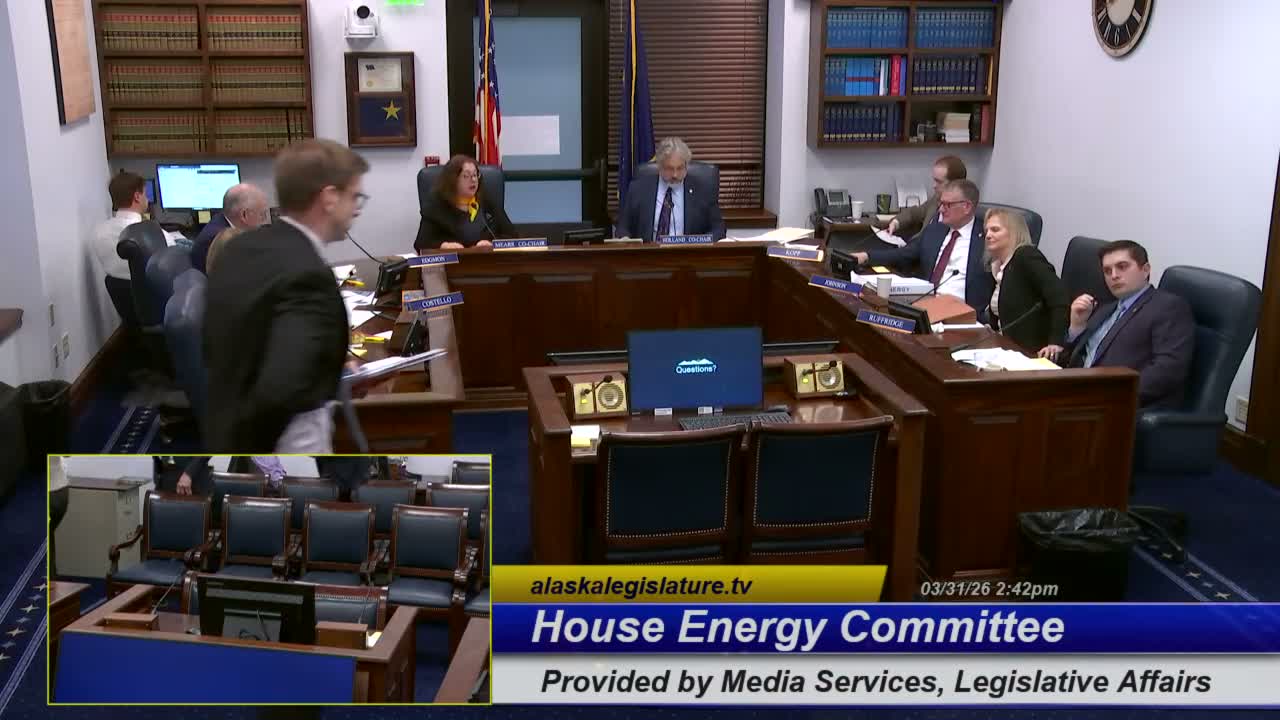
House Energy Committee adopts CS to HB 164 to delay, cap and sunset annual net metering program
Loading...
Summary
The committee adopted a committee substitute to HB 164 (the governor's annualized net metering bill) that delays the effective date to April 1, 2027, adds a 10-year sunset (with a 7-year consolation for near-deadline systems) and creates a mechanism to limit rate impacts on non-net-meter customers to 2% by allowing tariffs if the reimbursement fund is undercapitalized; the CS passed 6–1 and moves to Finance.
The Alaska House Energy Committee on Tuesday adopted a committee substitute to HB 164, the governor’s annualized net metering proposal, moving the bill to the next committee with a 6–1 roll-call vote.
Tim Truer, staff to Representative Holland, summarized three substantive changes in the CS: it moves the bill’s effective date to April 1, 2027; it creates a 10‑year sunset for the annualized net metering provisions (reverting to the prior status quo on April 1, 2037) while allowing qualifying systems built near the sunset to retain benefits for seven additional years; and it establishes a safety valve to protect non-net-meter customers by permitting utilities to implement new tariffs if a fund created to reimburse utilities is undercapitalized, with language intended to cap rate increases on non-net-meter customers to no more than 2%.
“As drawn from amendments presented to this committee, the CS moves the effective date, adds a sunset and introduces a path for utilities to establish tariffs if the fund is not sufficiently capitalized,” Truer said during the briefing. Committee members expressed support for the guardrails but asked for more specificity and fiscal detail.
Questions from members centered on how the reimbursement fund would be capitalized, who calculates ‘‘revenue loss’’ attributable to net metering and how the Regulatory Commission of Alaska (RCA) and Alaska Energy Authority (AEA) would implement the bill’s provisions. Truer and committee staff said the CS directs the RCA to adopt implementing regulations and assigns administration and fund disbursement authority to the AEA, subject to appropriation. Several members asked for a fiscal note and clearer metrics on how revenue loss would be defined and measured.
Representative Chuck Cupp commented that the CS “keeps net metering but it’s adding guard rails,” while other members pressed staff for opportunities to review metrics and to require earlier reporting to regulators if consumer-generator penetration grows. Committee members also discussed sunset review language and the possibility of a Legislative Budget and Audit Committee review before the statutory sunset.
After discussion, the committee voted on a motion to adopt the CS and reported HB 164 from the Energy Committee to the Finance Committee. A roll-call count recorded 6 yeas and 1 nay (Representative Refridge voted no). The committee chair said the CS will move forward with attached fiscal notes and with conforming changes as necessary.
The committee did not adopt a final capitalization number for the reimbursement fund during the meeting; staff said third-party estimates exist and that the RCA/A EA processes will be used to develop specific measurements and rulemaking.
The bill now proceeds to the Finance Committee for further review and any fiscal analyses.