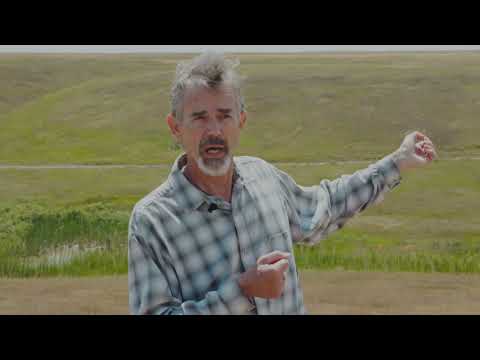
Rocky Flats tour shows shift from passive iron filters to battery-powered air stripping and enhanced monitoring
Loading...
Summary
On a site tour, a presenter described why passive zero-valent iron (ZVI) treatment lost effectiveness after a second source was tied in and outlined upgrades: a containerized air stripper powered by solar-charged batteries, flow-paced GS 10 sampling under the RFLMA, and continued telemetry and pond-breach plans to protect South Walnut Creek.
A presenter on a Rocky Flats site tour said the site’s groundwater treatment approach was altered after passive zero-valent iron (ZVI) systems began failing to meet standards when an additional source area increased flow and contaminant concentrations.
“Now, you're pushing more water through the same amount of ZVI, so there's less contact time with that iron,” the presenter said, explaining that reduced contact time prevented the ZVI from meeting treatment standards and prompted prototyping of additional measures.
Why it matters: the treatment systems are designed to prevent contaminated groundwater from discharging to South Walnut Creek. The presenter listed three source areas—the Moundsite, the East Trenches and an oil burn pit near the 903 Pad—that produce volatile organic contaminants, and said air stripping is effective at removing those dissolved organics.
The team tested air stripping at the mound and at the East Trenches Plume Treatment System (ETPTS). Today, ETPTS includes a containerized unit fitted with solar panels and batteries that power an air stripper. Inside the Conex container, batteries and a powered air stripper provide treatment where the passive ZVI system proved insufficient.
The presenter described how groundwater flows along a shallow alluvial layer above a low-permeability claystone and then peels off to drainages. To prevent discharge to surface water, the site uses collection trenches—perforated pipe bedded in sand and gravel—and a down-gradient plastic barrier that diverts water to treatment. He estimated the mound trench is a few hundred feet long and the ETPTS trench roughly 1,000 feet.
Monitoring and sample quality: the presenter said groundwater and surface-water sampling follow the Rocky Flats Legacy Management Agreement (RFLMA) Attachment 2, using qualified laboratories subject to periodic audits and field sampling protocols designed to avoid sample contamination. “We collect what are known as QAQC, or quality assurance, quality control samples,” he said, citing field duplicates and equipment rinse blanks as standard checks.
Surface-water sampling is flow paced at points of evaluation such as GS 10: the presenter said samplers are programmed to collect bottles by volume (for example, every 100 cubic feet), which captures conditions ranging from low flow to storm events, rather than relying on hand-collected bottles at scheduled times.
On radionuclide behavior, the presenter said plutonium and americium tend to move attached to soil particles during heavy downpours or hailstorms, while uranium is more soluble and becomes more prominent when groundwater comprises a larger fraction of streamflow.
Telemetry and system oversight: an on-site antenna and router relay sampler and treatment-system indicators (flow, carboy status, water levels) back to office systems and cell phones so staff can monitor conditions remotely. Treatment units are also instrumented so staff can detect stoppages or changes in flow without physical checks.
Pond management: the presenter noted five former ponds in the South Walnut Creek drainage; dams at four have been breached following coordination with regulators and engineered designs, creating wetlands behind the breached dams. He said the terminal Pond B5 remains and is planned for a future breach.
The tour concluded with the presenter noting continued monitoring and remediation under RFLMA requirements and operational oversight through telemetry and QA/QC sampling to ensure treated discharges protect surface water downstream.