Lifetime Citizen Portal Access — AI Briefings, Alerts & Unlimited Follows
Presenter outlines Rocky Flats plume treatment system, citing nitrate at roughly 60–70 times the site standard
Loading...
Summary
On-site presenter described the Solar Ponds Plume Treatment System (SPPTS) at Rocky Flats, explaining that groundwater nitrate is roughly 60–70 times the site's nitrate standard and summarizing the system's uranium-coagulation step followed by a denitrifying-bacteria nitrate treatment.
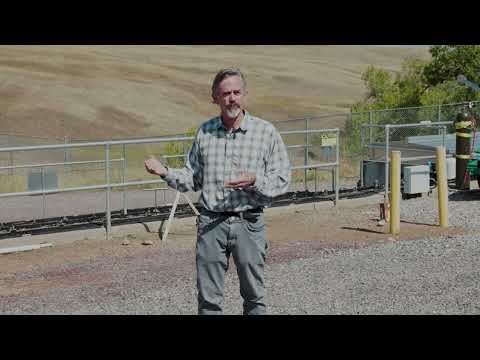
A presenter at the Rocky Flats site described the Solar Ponds Plume Treatment System (SPPTS), saying it collects and treats groundwater contaminated primarily by nitrate and, to a lesser extent, uranium.
"Nitrate's the primary contaminant" and is present at "approximately 60 to 70 times our standard," the Presenter said, adding that site-specific uranium concentrations are about four to five times the Rocky Flats standard.
The Presenter outlined how groundwater from an interceptor trench system (ITS) and a long collection trench—about 1,200 to 1,300 feet at this location—flows to an attenuation feature and then to a round holding tank. From there the combined water is pumped into a Connex housing the Uranium Treatment Component (UTC). The UTC doses the incoming water with aluminum sulfate (alum) to coagulate uranium-associated particulates, routes the water through successive mixing and clarifying tanks so clots settle, and removes the settled solids to an external waste container.
"The Uranium will stick to those little clumps and they'll all drop to the bottom," the Presenter said, describing the coagulation and settling process. After clarification the liquid is dosed with sodium hydroxide to neutralize acidity introduced by alum so downstream bacteria in the Nitrate Treatment Component (NTC) are not harmed.
The Presenter said treatability studies that began after problems with the original passive-media design led to a shift in approach. The system originally used reactive media—sawdust and iron filings in a large two-cell "big box"—intended to treat nitrate in the primary cell and polish uranium in the smaller cell. That design proved difficult to access and maintain, and it did not meet treatment goals at this site. "We had determined a good treatment method which relied more heavily on denitrifying bacteria," the Presenter said, citing results from studies through 2013–14.
Presenter emphasized why the work matters: without collection and treatment, contaminated groundwater would discharge to North Walnut Creek. Although nitrate can be biologically consumed downstream, the Presenter noted the site is required to meet a Rocky Flats nitrate compliance level of 10 milligrams per liter (as nitrogen); untreated groundwater at this location measures roughly 600 mg/L. For uranium the Presenter cited a Rocky Flats site standard of 16.8 micrograms per liter, noting the current drinking-water standard for uranium is higher at 30 micrograms per liter.
The Presenter also described operational and safety details: the ITS network of subsurface pipes totals roughly two miles, portions were installed in 1980–81, the SPPTS Connex and treatment equipment operate off solar panels and battery power because the site lacks utility hookups, and staff follow strict, activity‑tailored PPE requirements when handling chemicals. The Presenter said alternative coagulants (polyaluminum chloride) have been tested at smaller scale and could remove the need for sodium hydroxide dosing under some conditions.
No formal decisions or votes were recorded in the presentation; the session was a technical briefing on the system's configuration, past repairs (including excavation and valve access restoration around 2006), and the current chemical and biological treatment sequence.