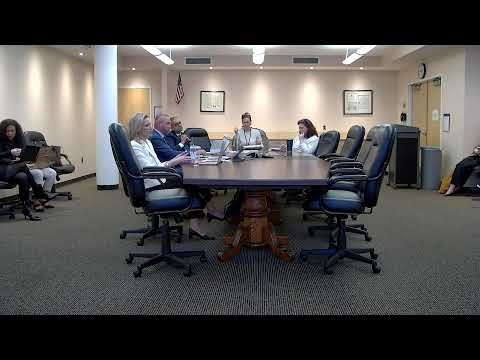
Schreiber director of guidance details college-counseling overhaul and local admissions results
Loading...
Summary
Justin Arrini, Port Washington’s new director of guidance, told the curriculum committee that Schreiber students continue to post strong college outcomes but face a more complex admissions landscape; he outlined data-driven counseling changes, new family outreach, grant-funded programs and plans to rebuild data systems.
Justin Arrini, the district—s director of guidance, told the Port Washington curriculum committee that the school—s college-counseling work has shifted from year-end application help to a multiyear, equity-focused program aimed at improving long-term student outcomes.
"We—re not just helping students complete applications anymore," Arrini said. "We—re guiding them through a multiyear program and process that includes academic planning, social-emotional support, and long-term goal setting." He framed counseling as a series of four phases—exploration, planning, application assistance and financial-aid navigation—that begin as early as ninth grade.
Why it matters: Arrini showed the committee local results and national trends to argue for earlier, more individualized advising. He said 90% of the Class of 2025 pursued postsecondary education and that, of those who went on to college, about 93.7% enrolled in four-year institutions. The presentation stressed that strong test scores and grades no longer guarantee admission because institutions use a wider set of strategies—including expanded early programs and active recruitment—to shape incoming classes.
Key data and context: Arrini said Schreiber students outperform New York averages on standardized tests and advanced coursework. He cited a higher-than-average ACT composite (about 28 versus a New York State average of 25) and strong SAT benchmark attainment. AP participation is high: roughly 80% of students take at least one AP course, about 60% take three or more, and near 47% take five or more APs before graduation. Schreiber also received College Board AP access recognition in 2025.
Admissions strategy and examples: Using five years of local application data, Arrini flagged early decision—s outsized role at selective schools. For students in UPenn—s published middle 50%, he reported a Schreiber acceptance rate of about 31%, and he said 92% of those admits had applied early decision. For Cornell, his slide showed 141 Schreiber applicants with 34 accepts (about a 24% acceptance rate). He pointed out that public state schools often show a large in-state advantage; for example, he contrasted higher in-state acceptance rates with single-digit out-of-state rates at some institutions and said roughly 10 Schreiber students gained admission to UT Austin this year despite out-of-state disadvantages.
Scale and operational impact: Arrini quantified workload for counselors: the current senior cohort had submitted roughly 6,264 applications to about 499 institutions, including more than 2,700 early applications, which he calculated as about 750 transcript/application requests per counselor and an average of roughly 16 applications per student. He said that volume drives the need for better data systems and administrative support so counselors can spend time on individual student advising.
Planned changes and programs: To address those demands, Arrini outlined four priorities: build counseling capacity, strengthen systems, expand access and equity, and measure outcomes. Specific initiatives include:
- A reimagined college-and-career center in Room 112 to serve as a hub for college reps, family technology access, career programming and small-group advising; the counseling office has applied for an education foundation grant and the high-school HSA has volunteered support.
- Pursuit of grant-funded test-preparation partnerships to supplement free online options such as Khan Academy and to provide more individualized SAT/ACT preparation at low or no cost to families.
- Expanded outreach to ELL and first-generation families, including Spanish-language college information sessions; Arrini said an assistant director of admissions from Binghamton University recently presented a Spanish-language session for families.
- Data improvements: Arrini said the district is rebuilding its data tools (beyond Naviance), adding staff with data expertise (naming Jeanne Welch) and aiming to produce more reliable school-specific analytics for advising by next year.
Addressing fit and postsecondary options: Committee members asked about noncollege pathways and how the department supports students who pursue careers, trade schooling or the military. Arrini said the center will serve all postsecondary paths and that counselors provide individualized, equitable supports regardless of the student—s chosen route.
Measuring outcomes: Arrini said the district will introduce a senior exit survey this year to capture contact information, alumni interest and qualitative feedback, and that the National Student Clearinghouse data will be used to study summer melt (students who commit but do not enroll) and longer-term enrollment and transfer patterns.
Committee concerns and context: Members pressed on sample sizes for some school-level statistics, the limits of predictive models given holistic review practices at some colleges, the potential financial risks of binding early-decision applications and the trade-offs of very high AP participation. Arrini acknowledged data gaps, said the counseling office will continue to refine methods and stressed an individualized approach to avoid undue stress on students.
What's next: The committee chair announced the next curriculum committee meeting is scheduled for May 8, when the group will discuss building-level equity teams.
Attributions: Quotations and specific statistics in this article are attributed to Justin Arrini (director of guidance) and to members of the Port Washington curriculum committee during the March presentation and Q&A.