Get Full Government Meeting Transcripts, Videos, & Alerts Forever!
Get email alerts on the Surveillance Cameras topic
No spam. Unsubscribe anytime.
Mount Vernon council votes to turn off and cover Flock ALPR cameras until contract ends
Summary
After hours of public comment and council debate about privacy and public safety, Mount Vernon City Council voted to turn off and cover the city’s license‑plate reader cameras until the Flock contract expires in November 2026. The 3‑4 roll call split followed competing arguments about investigatory benefits and data‑sharing risks.
Mount Vernon — The City Council voted on March 11 to turn off and cover all of the city’s license‑plate reader (ALPR) cameras and keep them covered until the current contract expires in November 2026. The roll call vote was 3 in favor (Vanderstoop, Oliver, West) and 4 opposed (Tercero/Tricero, Hudson, Beaton, Damon).
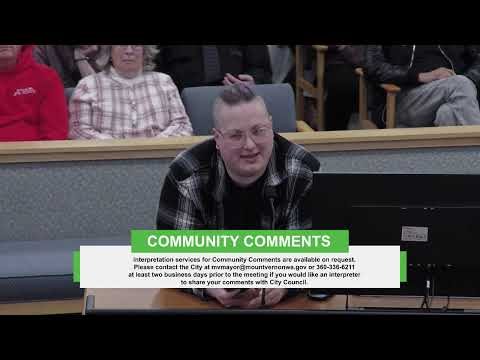
The decision followed a lengthy public comment period in which many residents urged the council to cancel the city’s contract with Flock, the company that supplies the ALPR network. “My issue is with Block, the company, not with the Mount Vernon PD,” said Andrea, a Mount Vernon resident who read contract language aloud and described machine‑learning uses and a lack of local control. Advocate Sage Wilkirk told the council that crowdsourced and city transparency portals list between six and eight Flock cameras in Mount Vernon and noted the city spent about $30,000 of American Rescue Plan funds on the system in 2024.
Supporters of keeping the cameras argued they can be an effective investigative tool. Police Chief Christman told the council the system had been used as video evidence in serious cases: “We convicted four people for murder using flock cameras and cameras primarily as video evidence,” he said, and warned that turning them off would remove a “very powerful tool” for detectives.
Council members split over the tradeoffs. Council member West, who moved to add the item to the agenda, said the decision is driven by concerns about legality, effectiveness and a cost‑benefit calculation: the city has asked whether a network that generates large amounts of data but yields relatively few convictions is worth the privacy risk. Council member Oliver, who made the motion that passed, echoed residents’ demands: “I would like to see us get rid of these flock cameras,” he said prior to the vote and then moved to turn them off and cover them until the contract’s end.
Several council members said they had spent time reviewing public comment and state deliberations on recent legislation (Senate Bill 6002) that tightens controls over ALPR use and records. Some members argued the new state rules offer an adequate regime for oversight; others said they were not convinced and wanted immediate local action.
The motion directs city staff and the police department to power down and physically cover the ALPR units until the contract lapse in November 2026. Chief Christman said officers would comply but asked the council for time and a transition plan, noting the department is understaffed and that removing the system will increase investigative workload for detectives and patrol.
Next steps: Council asked the chief to provide an implementation and transition plan describing immediate operational impacts, alternative systems (if any), and timelines for bringing a locally controlled solution forward. The city also terminated some MOUs with private retailers during the meeting as staff began work to comply with the council’s direction. A NOFA or plan for equipment replacement was not set the same night; council discussion continues in committee as staff pursues options.
Votes and procedural note: The motion was moved by Council member Oliver and seconded by Council member West; the subsequent roll call produced the 3‑4 outcome noted above. The item’s discussion and vote are recorded in the council transcript beginning with public comment on Flock cameras and concluding with the roll call at the end of the meeting.
The council’s action does not alter other council business heard earlier in the evening, including land‑use approvals, CDBG hearings and a parks project approval.