Lifetime Citizen Portal Access — AI Briefings, Alerts & Unlimited Follows
Michigan utilities: MPSC chair cites measurable reliability gains but acknowledges affordability pressures
Loading...
Summary
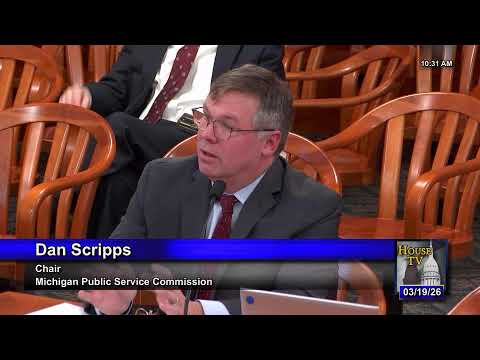
Dan Scripps, chair of the Michigan Public Service Commission, told lawmakers the state has seen measurable grid reliability improvements and launched transparency tools, but members pressed the commission on rate increases, data-center contracts and affordability for low-income households.
Dan Scripps, chair of the Michigan Public Service Commission, told the House Appropriations subcommittee the commission has focused on distribution reliability, consumer assistance programs and transparency tools and that the commission’s staff plays a consistent role in all cases. "Our mission is to serve the public by ensuring safe, reliable, and accessible energy and telecommunications services at reasonable rates," he said.
Scripps highlighted measurable reliability improvements since 2019 — including material reductions in outage duration indices and significant increases in tree-trimming miles — and said the commission has required distribution plans, technical standards and third-party audits to drive improvement. "Michigan, since 2019, has led all states in baseline reliability improvements," he said, noting both normal-condition and storm-condition metrics improved.
On affordability, Scripps acknowledged that Michigan residential rates rank among the higher states by rate level but said average annual energy bills (combining electricity and natural gas) are below the national average, and he pointed to expanded Michigan Energy Assistance Program (MEAP) eligibility and funding. "The amount of assistance is also increasing," he said, noting MEAP projections that would raise available funds significantly.
Committee members pressed the commission about data-center contracts and the potential costs to other ratepayers. Scripps said the commission reviews utility contracts for large customers and does not itself enter into data-center contracts; he cited the DTE-Oracle (Green Chile Ventures) approval with long contract terms and guaranteed payments and said a DTE-Google contract was recently filed. He described guardrails (term lengths, credit/guarantee provisions and minimum purchase requirements) designed to protect other customers if a large customer fails to show up. "All of the rest of that is designed to essentially provide those guarantees and guardrails," Scripps said, and he said the commission seeks to ensure any additional costs are not borne by residential customers.
On rate-setting mechanics, Scripps walked the committee through the utility rate-case process under Public Act 3 of 1939, explaining the 10-month adjudicative timeline, use of a forward-looking test year and evidentiary review of capital and operating costs to determine what is reasonable and prudent. He said the commission approved about half of what utilities sought in revenue in 2025 after evidence review, stressing the commission evaluates each case on its record rather than on comparisons to other states.
Members repeatedly raised concerns about customers who cannot afford bills; Representative McKinney described constituents struggling to pay and emphasized MEAP running out of funds in 2024. Scripps said reforms expanded eligibility and funding caps so more residents qualify earlier, and he defended time-of-use rates as a tool that can help customers lower bills by shifting consumption away from peak-price periods.
Lawmakers asked for continued focus on affordability and on making sure capital spending yields the most reliability per dollar. The committee adjourned after Scripps answered questions and members urged action to address high bills for vulnerable households.