Get Full Government Meeting Transcripts, Videos, & Alerts Forever!
Get email alerts on the Budget topic
No spam. Unsubscribe anytime.
District projects $4.68M 2025–26 deficit under current assumptions; board discusses occupation tax and possible referendum
Summary
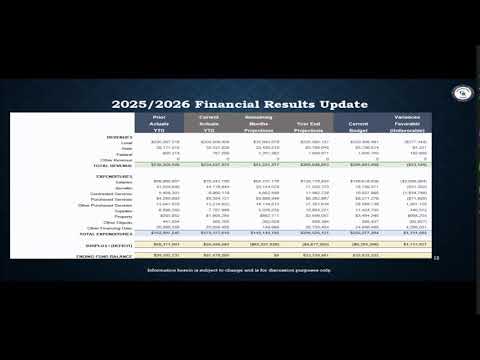
Staff presented year‑to‑date financials through February and a year‑end projection showing a $4,677,000 deficit for 2025–26 under current assumptions; the board discussed the district's $4M occupation tax and an option to consider a referendum to convert it into earned-income tax revenue.
District business staff provided a year‑to‑date financial update through February and a sensitive projection for fiscal 2025–26. Anthony Rapp summarized the numbers: the district currently shows a year‑to‑date surplus but, under projection assumptions, the year‑end deficit would be approximately $4,677,000.
Rapp explained that revenues through the early part of the fiscal year tend to show a surplus because local collections arrive early, but that salaries and benefits — especially contract increases and special‑education services — are the major cost pressures that could widen deficits later in the year. He said the district budgeted a larger deficit in anticipation of contract-driven costs but the current projection is about $1.7 million better than the adopted budget.
Board members asked about the occupation tax, which Rapp said generates roughly $4 million a year for the district, and discussed a referendum option to convert occupation tax revenue into an increase in the earned‑income tax. Rapp described mechanics for a referendum and noted distribution rules; board members said they would research whether neighboring districts have pursued and passed similar referenda.
Why it matters: the projection and the ongoing budget process affect fund-balance planning, capital transfers and bond ratings. Rapp emphasized that an actual deficit would be drawn from the district’s fund balance; he urged conservative budgeting and noted that final numbers will change as receipts and accruals are finalized.
Next steps: staff will continue to refine projections with March data and bring further budget analyses to upcoming meetings; no formal board decisions were recorded at this committee meeting.