Philadelphia City Council adopts series of ordinances and resolutions, including landlord-accountability rule and traffic changes
Loading...
Summary
At its March session, Philadelphia City Council adopted multiple ordinances and resolutions on final passage, including a nonresident landlord accountability ordinance, traffic-direction changes, red-light enforcement at Schoolhouse Lane and Henry Avenue, several land-bank property disposals and creation/compensation for the Office of Prison Oversight.
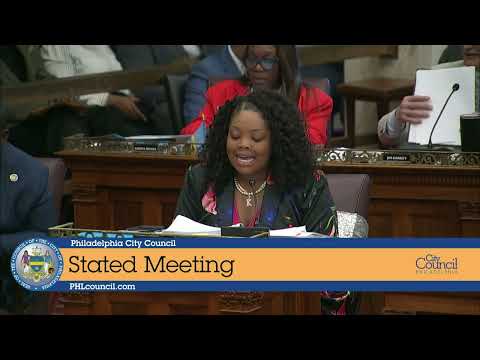
Philadelphia City Council on March 26 adopted a package of ordinances and resolutions on final passage, approving measures that affect property oversight, traffic regulation and new local offices.
The council voted, by roll call, to pass an ordinance amending chapter 9-3,900 of the Philadelphia Code to require nonresident landlords to provide verifiable contact information and a local agent and to establish penalties for noncompliance (ordinance 250,980-a). Council Member Dr. Anthony Phillips, a sponsor in committee-level debate, said the measure will speed enforcement and “provide a verifiable physical address, a phone number and a local Philadelphia agent” to improve response to code violations.
Council also approved traffic-direction ordinances (including West Lippincott Street between 22nd and 23rd streets) and an ordinance authorizing installation of an automated red-light enforcement system at Schoolhouse Lane and Henry Avenue (ordinance 251,068). During roll call for those measures the ayes were recorded unanimously by members present; for several items the chair announced the ayes were 13 or 14, with no nays.
Resolutions authorizing the Philadelphia Land Bank to dispose of multiple properties across councilmatic districts (resolution numbers 260,251; 260,252; 260,257 and others) were adopted, and the council approved a resolution naming the 5100 block of Chester Avenue as "Paul Ellis Hill Way" to honor a local community leader.
Separately, council passed legislation creating and funding the Office of Prison Oversight and a community oversight board, including provisions for compensation for the director and board members. Council Member Isaiah Thomas noted the measure followed a multi-year process and thanked advocates and administration staff who worked on the proposal.
All final-passage votes were taken by recorded roll calls; the clerk read titles and members' votes aloud. The council completed the calendar and moved on to member remarks before adjourning until April 9, 2026.
The measures now proceed to the mayor for signature where applicable, and several items will require administrative implementation by departments such as Licenses & Inspections or Streets and Services.