Lawmakers hear divided testimony on Election Day registration ballot initiative
Loading...
Summary
At a Special Joint Committee hearing on Initiative Petition 25-08 (H 5,001), election experts, proponents and municipal clerks debated allowing voters to register and cast ballots on Election Day. Witnesses agreed EDR can raise turnout but stressed planning, staffing and funding for smooth implementation.
The Special Joint Committee on Initiative Petitions met to hear testimony on Initiative Petition 25-08 (House Bill 5,001), a proposed law to allow eligible Massachusetts voters to register and cast a ballot on Election Day.
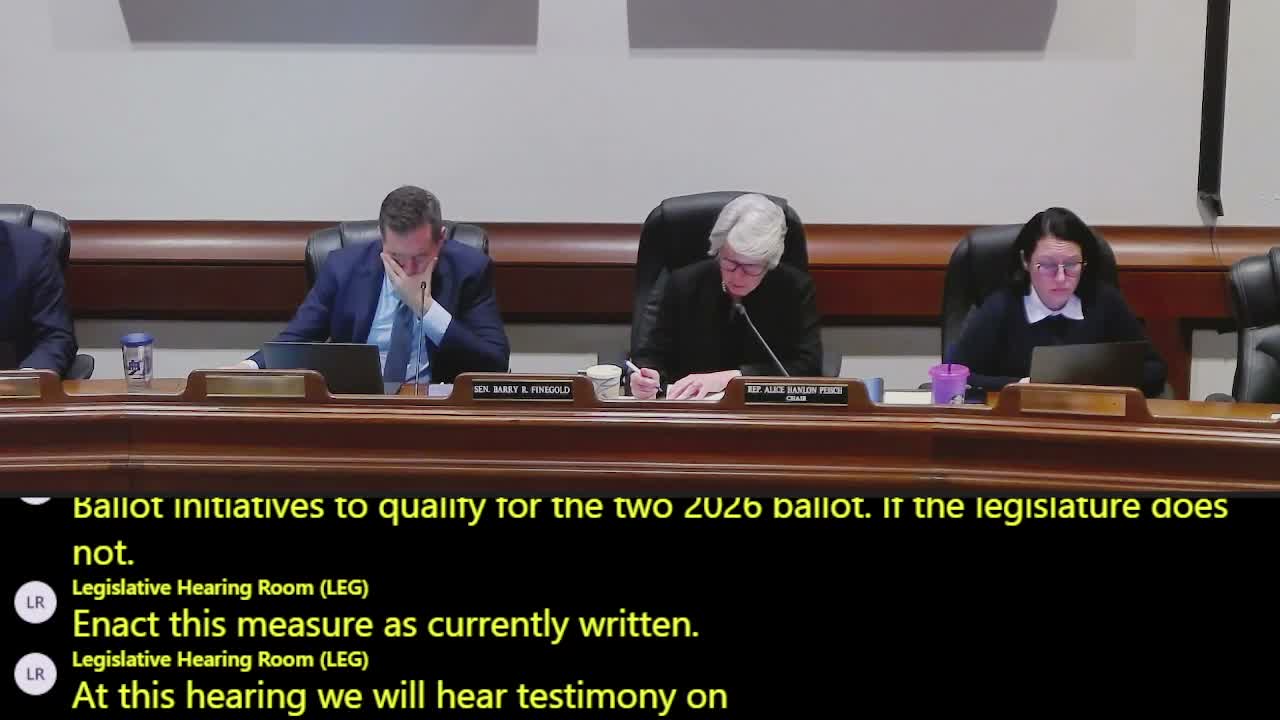
House Chair Alice Peich opened the hearing and outlined the process; panels of experts, proponents, opponents and pre-registered members of the public each had 30 minutes to testify. The committee accepted extensive questioning from lawmakers and closed the hearing after public comment, inviting written testimony to the committee record.
Experts described turnout and implementation trade-offs. "If Massachusetts adopts election day registration, it will very likely increase participation, especially among younger voters, renters, people who have moved recently, and communities that are less well served by advanced registration systems," said Costas Panagopoulos, professor of political science at Northeastern University. He cited the experience of Minnesota and Maine as examples where EDR has been integrated into routine administration.
Charles Stewart, director of the MIT Election Data and Science Lab, said H 5,001 "fits within the established range of EDR laws in New England and around the country" but warned implementation will determine success. Stewart said EDR often requires additional staff, clear procedures to avoid slowing check-in lines, and state support for local election officials.
Katie King of the National Conference of State Legislatures reviewed how states vary on documentation requirements, the use of provisional ballots and whether EDR is available only at certain locations. She noted about two dozen states plus Washington, D.C., permit some form of same-day or election-day registration and emphasized that proof-of-residency rules and public education should be explicit in statute.
Proponents, including Secretary of the Commonwealth William Galvin and volunteer organizer Norma Shulman, argued the petition preserves ID and oath requirements, narrows reconciliation timing for lists and would reduce the number of provisional ballots that go uncounted. "This will correct the fact that people who are qualified are sometimes turned away and their provisional ballots later are not counted," Galvin said, urging the Legislature to consider passing the measure before signature deadlines if possible.
Municipal officials and clerks urged caution. Dave Kaufman of the Massachusetts Municipal Association and Ben Kaufman, Brookline's town clerk, described increased election workloads and burnout after recent access expansions. They recommended that any EDR adoption be paired with funding, staffing relief and operational changes so clerks can carry out verification and administration without compromising accuracy.
On specific concerns: committee members asked about cost estimates, lines and fraud risks. Panelists said Washington state reported one-time state development costs near $60,000 and average local costs in the tens of thousands per election (often cited as $50,000'to'80,000), but that costs vary widely and may be front-loaded. Experts said no reputable research demonstrates systematic fraud caused by EDR; the principal challenges are administrative (training, staffing, equipment and public education).
Public witnesses were sharply divided. Jeff Cohen of Mass for Fair Elections opposed eliminating the 10-day deadline, citing verification and trust concerns. Advocacy and civic groups including Common Cause, MassVote, the League of Women Voters, the Urban League of Eastern Massachusetts and Partners in Democracy supported EDR, emphasizing benefits for renters, students, and communities of color; several witnesses cited provisional-ballot rejection rates as a reason to adopt a same-day option.
The committee did not vote. Chair Peich closed the hearing and said written testimony would be accepted electronically to the committee record. The committee's next steps and any potential legislation or report were not announced at the hearing.