Get AI Briefings, Transcripts & Alerts on Local & National Government Meetings — Forever.
Santa Fe hearing draws split views as Linea Energy seeks permits for large solar-and-battery project
Loading...
Summary
At a Santa Fe County hearing on two consolidated CUP applications, Linea Energy outlined a two‑phase solar-plus-storage project totaling roughly 349 MW paired capacity across nearly 2,900 acres; neighbors pressed the company on water use, wildlife fencing and battery‑fire readiness while health and climate groups praised the project’s jobs and emissions benefits.
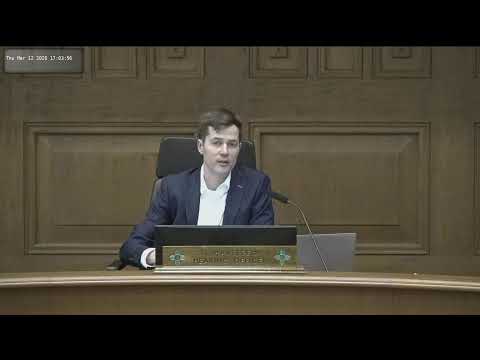
Hearing officer Taylor Hartstein heard technical presentations and public testimony at a Santa Fe County hearing on applications from Linea Energy LLC for two conditional‑use permits (cases 255180 and 255190) to build a large solar‑plus‑battery project in southeastern Santa Fe County.
Dominic Cisneros, Santa Fe County’s building and development supervisor, told the hearing that staff consolidated the two applications for hearing purposes and concluded the submissions meet the Sustainable Land Development Code’s CUP criteria subject to conditions. Cisneros summarized the proposal: Phase 1 would include about 199 megawatts of solar paired with 199 megawatts of battery storage on roughly 1,932 acres across 20 parcels; Phase 2 would add about 150 megawatts of solar and 150 megawatts of storage on roughly 960 acres. Staff reported a combined project footprint of nearly 2,900 acres (with a fenced development footprint the application estimates at roughly 2,002 acres) and described proposed infrastructure including a shared ~11.8‑acre collector area, a generation tie roughly 900–1,000 feet long and about 19.8 miles of access roads.
Andrew Davidson, a senior associate for Linea Energy, said the company bought the project in May 2024 and expects construction mobilization in late 2027, with commercial operation targeted for about May 2029. Davidson described the applicant’s public outreach and third‑party studies and said the project ‘‘meets all criteria for conditional use permit approval’’ and advances county and state renewable‑energy goals.
Jeff Weber, Linea’s director of engineering, presented technical details of the battery system and said Linea is likely to use lithium‑iron‑phosphate (LFP) chemistry, chosen ‘‘for lifespan, safety, reliability, and cost.’’ Weber described a containerized layout of battery modules, an integrated battery‑management system for remote monitoring and early alerts, and multi‑layer fire‑mitigation measures. He emphasized that final supplier selection is still to be determined.
Public testimony split largely along lines of safety and resource concerns versus climate and economic benefits. Neighbors near Stanley repeatedly raised water availability as a primary concern: June Morris, a Stanley resident, said many private wells in the area have gone dry and asked how much water construction will use and whether private wells would be affected. Nancy Wheeler cited Linea’s stated construction water figure of 67 acre‑feet over 18 months and asked the company to confirm calculations and whether a 60,000‑gallon fire tank could be refilled during an extended incident. Multiple speakers asked that swales and retention basins be lined to contain firefighting runoff that could carry contaminants.
Fire safety was another recurring concern. Victoria Clark, a retired registered nurse speaking for the Clean Energy Coalition’s steering committee, quoted a letter from the Los Angeles County Firefighters union warning of hazards at some battery‑energy facilities and urged the county to ‘‘do everything possible’’ to reduce risks. Technical witnesses for local advocacy groups and an electrical engineer who represents the Clean Energy Coalition urged careful specification of battery chemistry and enclosure spacing; Jim Wheeler asked Linea to guarantee at least 10 feet between containers and to clarify how water would be delivered in long‑duration incidents. Linea’s Jeff Weber and Brad Wilson emphasized industry safety standards, battery management and the planned first‑responder interface and said the county fire marshal and NV5/Glorietta technical reviewers had been included in staff conditions.
Supporters included local clean‑energy and public‑health organizations. The Clean Energy Coalition’s president, Lee Zlotoff, and representatives of Healthy Climate New Mexico and the Santa Fe Green Chamber of Commerce said utility‑scale solar and storage can deliver jobs, tax revenue and public‑health benefits from reduced fossil‑fuel pollution. Community organizers from projects that serve BIPOC youth urged the county to balance caution with the economic and environmental opportunities the project promises.
On conditions, Linea proposed two clarifications to staff language. Brad Wilson asked the county to allow drilling a new well ‘‘unless approved by the State Engineer’’ if an existing on‑site domestic well cannot be converted for operational use; he also asked that a staff condition requiring permitted and inspected access roads apply only to public roads (not private project driveways). Hearing officer Hartstein said he would confer with staff about the suggested wording changes.
Hartstein closed the record after public comment and the applicant’s brief response. He said he would issue a written recommendation with findings of fact and conclusions of law within 15 business days and noted the Santa Fe County Planning Commission may hold a public hearing on April 16, 2026. No final decision on the CUPs was made at the hearing.
What happens next: the hearing officer will file a written recommendation; the county’s process includes further opportunity for review and a planning‑commission public hearing; the record will include written materials already submitted and material presented today. Any substantive changes to the project design, supplier selections, or permitting documentation will be addressed later in the building‑permit and fire‑department review phases.
Quotes used in this story come from the public hearing transcript and are attributed to the speakers who made them.