Legislative hearing on 'all‑party' primary draws mixed expert evidence and competing claims
Loading...
Summary
A special joint committee heard expert testimony and testimony from supporters and opponents of initiative petition 25‑12 H (House No. 5003), which would create all‑party statewide preliminary elections. Experts described mixed evidence on turnout and polarization; proponents said the measure would expand competition and participation, opponents warned it would raise costs and empower wealthy donors.
The Special Joint Committee on Initiative Petitions heard testimony on initiative petition 25‑12 H (House No. 5,003), an act to implement all‑party state primaries, at a public hearing called to gather evidence for the Legislature.
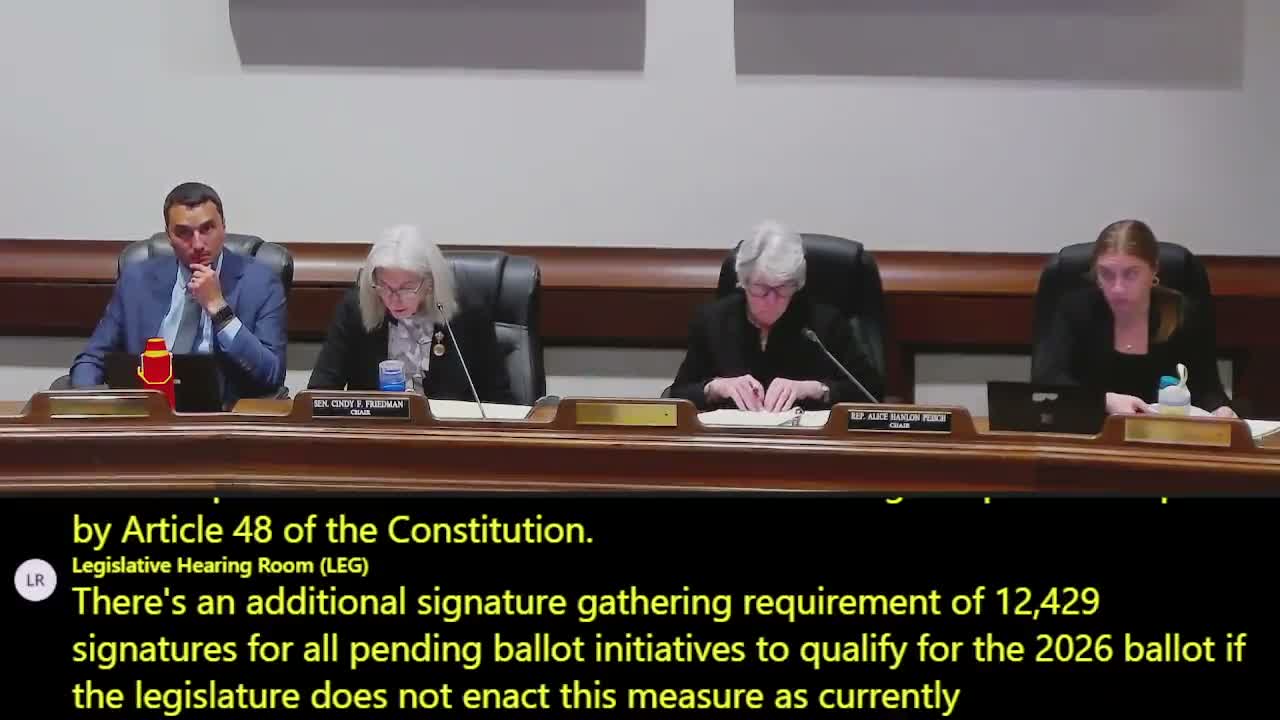
Sen. Cindy Friedman, the Senate chair of the committee, opened the hearing and explained the process under Article 48 of the Amendments to the Constitution of the Commonwealth and the additional signature threshold (12,429 signatures) required for measures to reach the 2026 ballot if the Legislature does not enact them.
Two academic and administrative experts gave the committee a cautious, mixed assessment. Costas Panagopoulos, distinguished professor of political science at Northeastern University, said the “top‑2” or “jungle” primary model can alter electoral incentives but noted the peer‑reviewed evidence shows limited and uneven effects on polarization. “The evidence does not show that top‑2 primaries reliably or dramatically reduce polarization,” Panagopoulos told the committee, adding that the reform produces trade‑offs — weakening party gatekeeping, increasing strategic candidate entry, and in some contexts boosting campaign spending.
Katie King, a policy associate for elections and redistricting at the National Conference of State Legislatures, summarized the array of multi‑party primary designs used elsewhere — top‑2, top‑4, nonpartisan top‑candidate systems, all‑comers runoffs and the older blanket primary model — and reviewed constitutional questions raised in past litigation (including California Democratic Party v. Jones). King told lawmakers that states adopting multi‑party preliminaries need significant voter education and administrative planning.
Proponents framed the initiative as a local reform to expand competition in a state they described as having many uncontested races. Danielle Allen, convening chair of the Coalition for Healthy Democracy, said the coalition collected roughly 100,000 signature sheets across 348 of 351 municipalities and argued the initiative would give voters — especially unenrolled voters — more meaningful choices. “No one is going to take time off, research candidates, juggle childcare and go to the polls when there are no choices on the ballot,” Allen said, arguing the measure would reconnect elected officials to broader electorates. Jim Henderson, counsel for the coalition, said the proposed statute would amend portions of Chapter 53 of the General Laws and that the attorney general found the petition consistent with Article 48 relatedness requirements.
Proponents emphasized a design choice in the petition that would allow party endorsements to appear on the ballot by joint request (a feature they said would preserve useful information for voters). Kevin Johnson of the Election Reformers Network and other panelists argued that the system could lower barriers for independents and third‑party candidates in some districts.
Opponents said the change could have unintended consequences and increase the influence of money in elections. Gina Frank, political director for 1199 SEIU Massachusetts, and Jordan Burke Powers, a former Partners in Democracy board member, warned that campaigns in other states using top‑2 systems became more expensive and that independent expenditures could flood contests. “This is a wolf in sheep’s clothing completely funded by billionaires,” Frank told the committee, citing post‑reform cost increases reported in some California contests.
Committee members asked detailed questions about turnout effects, endorsement and ballot mechanics (including references to Section 34 of Chapter 53), how parties would adapt nomination and endorsement processes, the petition’s signature gathering and funding, and the potential impact on representation for people of color. Proponents acknowledged variation by district and said the proposal was designed, in part, to incorporate Oregon‑style fusion endorsement rules so a candidate could carry multiple party endorsements shown on the ballot.
Public testimony included supporters — independent voters and civic groups — who said the change would help unblock noncompetitive races, and critics who reiterated concerns about money, complexity for voters, and potential harms to diverse candidates.
The committee did not vote; Chair Friedman closed the hearing and announced the committee will accept written testimony through Saturday, April 4 at 5 p.m. Instructions are posted on the hearing page at malegislature.gov and in the committee’s notice.
What happens next: the committee will compile testimony for its report under Article 48; members can use that record to recommend whether the Legislature should enact, modify or allow the measure to go to the ballot.