Brockton officials outline MSBA feasibility study and weigh new-build vs. renovation for Brockton High
Loading...
Summary
City and school officials presented early findings from a feasibility study for Brockton High, saying final recommendations are expected in April; options range from base-code repairs (largely nonreimbursable) to full replacement potentially eligible for substantial MSBA reimbursement. Residents raised costs, technology limits and the case for career-technical education.
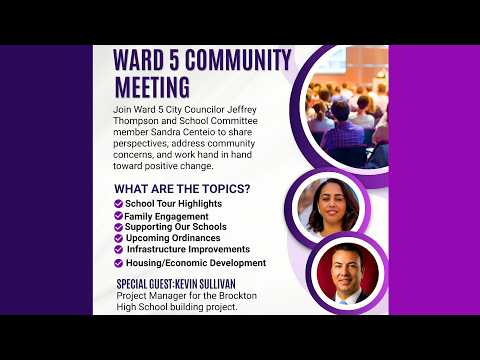
Jeff Thompson, Ward 5 city councilor, opened the meeting and introduced a presentation on the Brockton High School building project and the city’s work with the Massachusetts School Building Authority (MSBA).
Kevin Sullivan, the project director and manager, told residents Brockton is in MSBA module 3 of a multi-year process and said the team is still conducting a feasibility study to compare repair, partial renovation and replacement options. He said the city expects to select a preferred option in April and, if moved forward, to enter schematic design from May through October and seek state approval the following December.
Sullivan emphasized the funding trade-offs that are central to the decision: a base repair or code-only update is unlikely to receive MSBA reimbursement, meaning the city would pay most or all of that cost, while a new-building option could be eligible for significant state support. "The MSBA will reimburse upwards of 80% of eligible costs," he said, creating a value proposition between spending for short-term repairs and investing in a new building that would last decades.
Craig Olsen of KBA Architects summarized the condition assessment and educational-visioning work. He said many building systems and the exterior envelope are original or dated and that remodeling to meet current code and educational expectations can be costly. Olsen stressed the study is driven by educational goals — not just physical repairs — and that design decisions will aim to support modern instructional approaches.
Principal Kevin McCaskill framed the project as a long-term investment in students and workforce development, urging a collaborative process that includes teachers, parents and students. He argued for expanded career-technical education so "every single student that walks out of that school will have a marketable skill," and said Brockton’s current electrical and technology capacity limit instruction: students sometimes cannot get online during assessments because the building has exhausted its grid capacity.
Residents pressed the team about reported cost ranges. One attendee cited published figures in the low hundreds of millions and higher estimates approaching $700–$800 million; Sullivan said those wide ranges reflect different scopes and stressed updated estimates were coming in the next weeks. He reiterated that the state’s reimbursement rules materially change the city’s net cost for reconstruction versus repair and that the team will present more precise figures when schematic design yields a budget.
Why it matters: Brockton’s decision will shape secondary education and capital spending for decades. The favored option will determine whether the city largely funds an extended life for the existing campus or secures state support for a building designed around current learning models and expanded technical programs.
Next steps: The project team will refine cost estimates, present a recommended option in April, and — if the city advances schematic design — return to the community with a budget and timeline for potential state submittal.