Get Full Government Meeting Transcripts, Videos, & Alerts Forever!
Get email alerts on the Language Access topic
No spam. Unsubscribe anytime.
Training walks staff through how to read translation vendor quotes
Summary
A virtual training session guided staff through reviewing translation vendor quotes, focusing on per-word/page/hour pricing, desktop-publishing and file-conversion charges, translation-memory impacts, quality assurance, and practical questions to pose to vendors.
A virtual training session guided staff through how to read and question translation vendor quotes, highlighting common costs and clauses and surfacing practical questions for procurement and program staff.
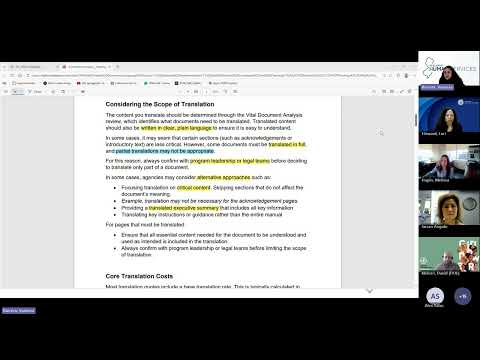
The session leader (S1) opened by explaining the agenda and shared a vendor-quotes handout and two sample quotes for a hands-on group activity. The presenter emphasized that translation scope matters and recommended confirming with program leadership or legal teams before shortening documents; "not all cases is it appropriate to only translate partials," S1 said, arguing that preserving meaning sometimes requires full translation.
Why it matters: Language access work often touches budgets and service quality. The training framed vendor oversight as a tool to control costs while protecting meaning for people with limited English proficiency.
The presentation stepped through common vendor pricing structures. S1 described per-word rates (noting vendors often bill on the target-language word count), per-page rates (typically 250–300 words per page), and per-hour charges for project management, formatting and editing. Quality-assurance work — often done by a second linguist — can be included or charged separately. S1 said translation-memory match types (no match, exact repetition, and fuzzy matches) affect pricing because reuse lowers cost.
Desktop publishing (DTP) and file-prep were highlighted as frequent and avoidable cost drivers. S1 explained that design-heavy items such as brochures, flyers and presentations commonly trigger DTP fees and noted that right-to-left languages (Arabic, Persian) and languages that expand text (Spanish, French, Portuguese) can require additional formatting. S6 reported that in their sample quote "DTP was one of the highest costs," and several groups recommended asking vendors whether DTP is necessary or can be scoped out if the source file is editable.
Participants in breakout groups raised operational questions they recommended adding to vendor checklists: which dialect will be used for Arabic, whether project-management fees are bundled or itemized, how many revision cycles the vendor provides, and whether the vendor uses human translators, machine translation, or a mix with human vetting. S8 (Adresa) and others urged checking translators’ certifications for specialized needs (medical or legal).
A flagged contract term also drew attention: S5 quoted a vendor clause suggesting that "for projects under 1,000 words... specifications may not apply," which participants found surprising. S1 confirmed those clauses appeared in returned vendor quotes and said the team would follow up with Ana Paula for further clarification.
The session concluded with practical takeaways: review the full quote line-by-line rather than only the total, ask vendors to explain line items (DTP, project management, QA, TM pricing), consolidate small projects to avoid repeated minimum fees, and plan ahead to avoid rush charges. S1 shared a topic-suggestion form and said she would follow up on unresolved questions raised in the activity.
The training offered staff a checklist of vendor questions and several examples to use when requesting or evaluating translation quotes; organizers said they would consider a future session focused on vendor coordination, phone-tree strategies and procurement workarounds.