Get Full Government Meeting Transcripts, Videos, & Alerts Forever!
Get email alerts on the Lead Service Line Replacement topic
No spam. Unsubscribe anytime.
Village hears options for lead service-line replacements after sampling finds 17 affected homes
Summary
Village staff reported 17 confirmed lead service lines and a 90th-percentile result well under the EPA limit, but one outlier exceeded the standard; the board will consider funding and scope options and expects a formal action on July 17.
Village staff briefed trustees on the status of the lead service-line inventory and replacement planning, saying the village has identified 17 homes with confirmed lead service lines and completed a 40-site sampling plan.
"We had to do a service line inventory... There were 17 homes in the village with lead service lines," said Mark Montgomery, the village operator, explaining the inventory and sampling process and the requirement to calculate a 90th-percentile lead result for compliance.
Montgomery told the board the village's current 90th-percentile measurement is 1.79 parts per billion, well below the EPA maximum contaminant level (MCL) of 15 ppb. He warned, however, that one sampled site tested above the MCL and that replacing that outlier would materially lower the 90th percentile.
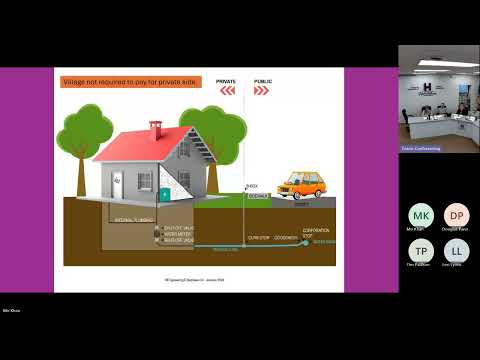
Trustees focused discussion on who should pay to replace the private portion of a service line. Montgomery explained the village is responsible for the public portion up to the b-box while homeowners are generally responsible for the private side under the village code; he noted EPA waivers exist if a homeowner refuses entry.
"If you choose to do that option and you get a homeowner that just refuses, then there's EPA waivers that they could sign," Montgomery said, describing the options if owners decline replacement work.
Several trustees urged pursuing grants or congressional assistance before deciding to require residents to pay. One trustee argued the village already collects capital fees intended to cover projects like this and said the village should avoid asking homeowners to pay the full $15,000 estimated per replacement.
Staff presented preliminary cost figures: roughly $15,000 per full-service replacement, or about $255,000 for the 17 identified homes if all were done at once. Staff said the legal requirement to begin replacements starts in 2027 at a minimum pace of 7% per year (about two services per year for this village). Montgomery recommended the board authorize further engineering and budgeting work to define a multi-year approach.
Village Manager Jay Hedges told trustees staff will return with an action item on July 17 and recommended authorizing an engineering scoping study. "We will be asking for your action on July 17... but we wanted to give you some time to understand this and ask questions tonight," Hedges said.
What happens next: staff will provide cost and scope options at the July 17 meeting, including a recommended authorization for an engineering study to decide whether to replace the private portion, perform holistic street/main upgrades, or phase replacements over multiple years.