Prescott Valley studies plan to host tier‑1 junior hockey team at Findlay Toyota Center
Loading...
Summary
Town officials, venue managers and an independent consultant reviewed a proposal for a tier‑1 junior hockey team and associated ice programming at the Findlay Toyota Center. Presentations outlined projected ticket revenues, estimated town tax receipts and infrastructure upgrades; no council vote was held.
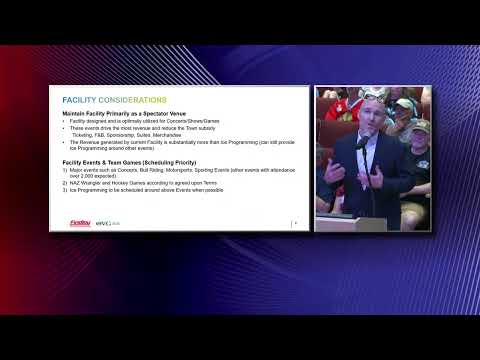
Prescott Valley officials, venue managers and residents gathered March 26 for a special study session to review a proposal to bring a tier‑1 junior hockey team and expanded ice programming to the Findlay Toyota Center. Presentations by the arena’s general manager and an independent consultant outlined operating projections, required capital upgrades and likely local economic impacts.
The council convened the session to learn about the opportunity; the meeting was informational only and did not require or produce a council vote. Town staff and venue management said they will continue discussions with prospective leagues and operators while assessing fiscal and operational tradeoffs.
Shane Cadwell, general manager of the Findlay Toyota Center, told the council the arena hosts roughly 110 events annually and averages about 235,000 attendees a year. Cadwell said the facility’s four‑year average revenue is about $1.24 million and that the town currently provides roughly a $600,000 annual subsidy to cover the gap between revenue and operating costs. "For venues in markets our size, that's the majority need some sort of subsidy," Cadwell said, adding that a stable tenant could help reduce that subsidy over time.
Cadwell described the hockey proposal as a two‑part model: a team tenant with a roughly 32‑game home schedule and expanded ice programming for community and youth use. He said the team and programming scenarios the venue modeled ranged from 1,500 to 3,500 tickets per game. Using a mid‑case of about 2,500 tickets per game, Cadwell said team nights and related revenues could generate roughly $868,000 in annual event revenue, with seasonal expenses modeled near $600,000 and a projected seasonal net of about $270,000 to the facility under that scenario. Cadwell cautioned that the building — now roughly 20 years old — would require upgrades over time, including improved dashboard systems, new netting, Zamboni upgrades, locker‑room work and eventually a chiller‑plant replacement.
An independent analysis by Rounds Consulting, presented by Luis Cordova, placed the proposal’s broader economic impact in a range of outcomes tied to attendance and how much out‑of‑town visitation the team can attract. Cordova said the firm estimated the opportunity could support between 70 and 84 full‑time equivalent jobs, generate about $4.2 million to $5.1 million in labor income, and produce roughly $11.8 million to $14.6 million in economic activity annually. He estimated the town could collect approximately $119,000 to $272,000 in new tax revenue each year from the activity, driven by ticket, food and beverage and visitor spending. "The success of the opportunity really depends in part on the team's ability to draw from a broader regional market," Cordova said.
Council members and the vice mayor framed the discussion around two priorities: fiscal responsibility and community benefit. The meeting’s moderator emphasized the council’s role as fiscal overseer rather than a booking authority, saying the session was intended to inform the town’s assessment of risks and opportunities. One council member noted the consultant’s recommendation that marketing target regional markets outside town limits — such as Flagstaff — and asked that marketing responsibility be assigned if the initiative advances.
Public commenters largely supported the proposal as a vehicle for youth sports and community building. "We're not just talking about one team — we're talking about a whole community," said Nick Casten, a local business owner and youth hockey coach who described junior hockey as a development pathway for players and families. Eric Tetro, vice commissioner of the Parks, Arts and Recreation Commission, urged council to consider tourism and bed‑tax benefits from visitors who would stay in local hotels. Parent and longtime junior hockey advocate Ken Swamin described the culture created by junior teams — host families, school visits and charitable events — and urged the council to consider those long‑term community benefits.
No formal direction or vote was taken at the meeting; speakers said staff and venue management will continue evaluating league specifications, potential contracts and costs, and will bring additional information back to the council if and when formal action is needed. The meeting closed with council and staff thanking speakers and encouraging continued public engagement on the proposal.