Valley Water outlines Water Supply Master Plan 2050, recommends lower-cost adaptive strategy
Loading...
Summary
Santa Clara Valley Water District staff briefed the planning commission on the Water Supply Master Plan 2050, explaining projected shortages under multiple scenarios and the board's adoption of a 'lower cost' adaptive strategy that prioritizes potable reuse, diversified storage and annual progress reporting.
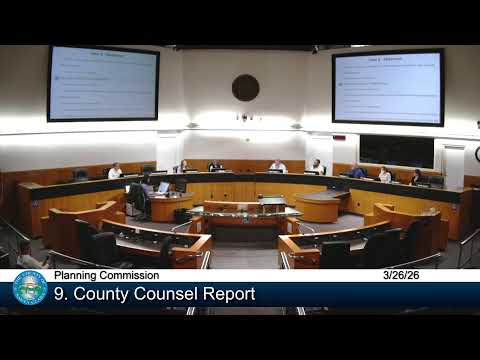
Santa Clara Valley Water District presented its Water Supply Master Plan 2050 to the Santa Clara County Planning Commission on March 26, describing projected shortages across four modeled future conditions and recommending an adaptive, lower-cost strategy adopted by the board.
Kirsten Strouff, assistant officer for Valley Water's water supply division, said the plan—developed over three years—models two demand and two imported-supply projections and shows the existing system would experience shortages in drought conditions without additional investments. Strouff summarized the district’s infrastructure (10 reservoirs, treatment plants, recharge ponds and more) and said about 30% of county supply is local, 50% is imported, 15% comes from conservation and 5% from reuse.
To address shortages, the district evaluated potable reuse, local and imported surface-supply projects, storage and recharge, and groundwater banking. The board adopted an approach the staff described as 'lower cost' and adaptive; it focuses on potable reuse (goal of 24,000 acre-feet per year by 2035 and up to 32,000 AF by 2050), diversifies storage and secures imported supplies while relying on annual reporting and decision triggers to adjust investments. Strouff said the lower-cost versus higher-cost strategies are differentiated in part by inclusion of the Sites Reservoir and different assumptions about groundwater banking.
Commissioners asked about desalination feasibility, recycled 'purple-pipe' nonpotable networks, sea-level rise and the status of Semitropic groundwater-bank negotiations. Valley Water said it is completing a desalination feasibility study this year but warned of brine-discharge challenges in the South Bay. Staff said purple-pipe expansion is led by local agencies and is not used for groundwater recharge because Valley Water policy requires purified water for recharge. Aaron Baker, Valley Water chief (speaking during Q&A), said the Semitropic contract—currently used for groundwater banking—will require renegotiation before it expires in 2035 and that water-quality issues (arsenic, TCP) and evolving regulations will change future capacity and costs.
The commission had no public speakers on this item and closed the hearing after commissioners’ questions.