Open Space Authority outlines CVcamp proposals to protect Coyote Valley and seek public feedback
Loading...
Summary
The Santa Clara Valley Open Space Authority presented the Coyote Valley Conservation Areas Master Plan (CVcamp), described restoration and public-access alternatives, highlighted past acquisitions and partnerships, and said a citizens' parcel tax (Measure D) would appear on the June ballot to bolster funding.
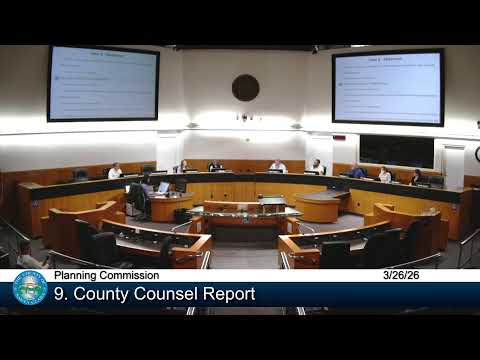
The Santa Clara Valley Open Space Authority told the Santa Clara County Planning Commission on March 26 that the Coyote Valley Conservation Areas Master Plan (CVcamp) seeks to conserve habitat, support agriculture and expand public access across the valley. Lena Drap, the authority's conservation policy specialist, and Jennifer Peth, senior open space planner, reviewed the agency’s mission, funding and a set of conceptual alternatives for restoration and trails.
Drap said the authority is funded primarily through local parcel tax measures—Measure Q and Measure T—and receives roughly $12 million per year from those sources, which the agency leverages with state, federal and private funds. Peth described Coyote Valley as a critical landscape linkage between the Santa Cruz Mountains and the Diablo Range and noted Assembly Bill 948 designates the valley as a landscape of statewide significance and authorizes the authority to administer the Coyote Valley conservation program area.
The CVcamp alternatives under consideration range from limited to extensive grading, with larger grading options offering more opportunities to increase Fisher Creek sinuosity, expand Laguna Seca wetland area and enlarge riparian habitat but costing more and involving more landscape change. The authority also proposed two regional trail segments and four potential public-access destinations, from a Laguna Seca overlook to an agricultural gateway, and said public input is being solicited via traveling exhibits and an online survey at openspaceauthority.org/cvcamp. The presenters said prior acquisitions—including 937 acres protected in 2019 through partnerships with Peninsula Open Space Trust and the City of San Jose, supported by a $46 million contribution from San Jose’s Measure T—have advanced habitat protection.
Commissioners asked about funding stability and acquisitions. Mark Landgraf, assistant general manager, said the authority will not advocate on elections but confirmed a citizen-initiated parcel tax (Measure D) is on the June ballot; he described it as a 2¢ per building-square-foot charge (roughly $32 for an average home), capped at $7,500 per parcel, that could raise an estimated $17 million per year. Commissioners also pressed the authority on coordination with high-speed rail and wildlife undercrossings; Peth and Landgraf said the authority and partners, including POST, are working on undercrossings and culvert improvements to maintain and improve connectivity.
The authority emphasized that CVcamp is a multi-benefit effort—habitat connectivity, flood risk reduction, climate resilience, agriculture and public access—and that next steps include selecting a preferred concept and environmental review in 2027–28. The commission heard no public speakers on the item and closed the hearing after questions.