Kennewick lobbyist outlines 2026 legislative wins, revenue risks and local appropriations
Loading...
Summary
Brianna Murray, the city's Olympia advocate, told the Kennewick City Council the 2026 session produced capital appropriations for two local projects but left uncertainty over a proposed income tax and sales/use tax exemptions that could reduce city revenues unless mitigation is enacted.
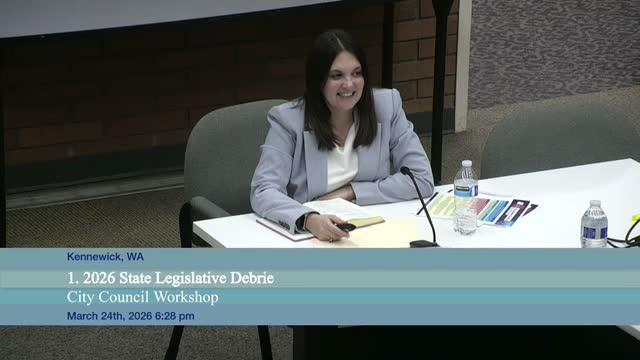
Brianna Murray, a lobbyist and partner at Gordon Thomas Honeywell who represented Kennewick in Olympia, told the City Council that the 2026 short legislative session produced relatively few enacted bills but several measures with notable local implications.
Murray said lawmakers passed 267 bills this session, the fewest since 2014, and that the majority party focused on a package that included a proposed income tax on very high earners paired with sales and use tax exemptions for items such as diapers, hygiene products and some services. "They also exempted those products from local sales and use tax, which means it will have an impact on the city's revenue collections," Murray said.
Why it matters: Murray warned the city faces an unclear revenue outlook because the state proposal pairs local sales tax exemptions with a tentative $200 million mitigation fund for cities and counties in 2029. "The current legislature cannot bind future legislatures," she said, adding the mitigation number is "written in pencil." That uncertainty, she said, means the city should treat recent one‑time revenue bumps cautiously when preparing its budget.
Local wins and losses: Murray highlighted two capital appropriations Kennewick secured: about $93,000 for asbestos abatement at the Kennewick Activity Center and about $309,000 for HVAC improvements at the Toyota Center. She said those earmarks exceed the reported average appropriation per community from the capital budget (roughly $258,000).
On transportation, Murray said the legislature made no new investments and instead used bonding to preserve the current system; as a result, Kennewick's request for funding for an at‑grade rail solutions study received no appropriation. She also flagged the lack of new funding for public defense to meet recently released caseload standards, calling it a disappointment for cities.
Policy and implementation notes: Murray summarized several policy changes that will affect municipalities, including new restrictions and guidance on automated license plate readers (ALPRs) following a University of Washington study and public records litigation, a bill limiting law‑enforcement face coverings, and state mandates on how jurisdictions must treat "step housing" (emergency, transitional and permanent supportive housing). She advised the council to review ordinances and plan for compliance timelines, saying some revisions will be required in the next 18–24 months.
Council questions focused on the mechanics and local impact of specific bills. On the residential‑in‑commercial‑zones measure (Senate Bill 6026), Murray and city planning staff said cities may be exempt from certain requirements if local commercial zones allow tall building heights (an 85‑foot exemption was discussed), which could reduce local implementation obligations. On the proposed income tax and sales exemptions, Murray said the reliability of revenue projections is low and that the city should regard initial sales‑tax gains as potentially one‑time.
Next steps: Murray said she will deliver a comprehensive written report after the governor's sign/line‑item period concludes (she cited April 4 as the last day for gubernatorial action) and encouraged the council to engage the city's legislative delegation early as Kennewick develops its next budget. "If you buy into that argument, the $200,000,000 does fully mitigate cities and counties on the estimates for the other sales and use tax exemptions," she said, but cautioned the committee's plan is not a firm commitment.
Ending: Council members thanked Murray and staff for the briefing and asked staff to provide more detailed, city‑level estimates of potential revenue impacts as they become available.