Watermaster: Las Posas annual report shows declines in 2024–25; yield study says projects could avoid basin-wide ramp down
Loading...
Summary
The Fox Canyon board received the Las Posas Valley water-year 2025 annual GSP report and a basin optimization yield study showing groundwater declines during a dry year and a projected basin optimization yield of about 36,860 acre-feet if two major projects are implemented; the board authorized staff to submit the annual report to the Department of Water Resources and the court.
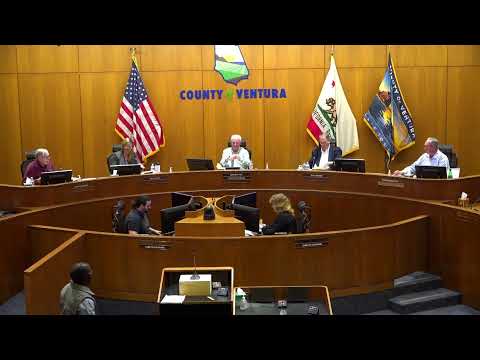
The Fox Canyon Groundwater Management Agency board on March 25 received a presentation on the Las Posas Valley groundwater sustainability plan (GSP) annual report for water year 2025 and a companion basin optimization yield study, and authorized staff to submit the annual report to the California Department of Water Resources and the court.
Dr. Farai Kasecki, presenting for Watermaster staff, said water year 2024–25 was “a critical water year” with below-average precipitation that led to increased groundwater extraction and declining groundwater elevations in parts of the basin. He told the board that, while most management areas remain above minimum thresholds, some wells show continuing downward trends toward those thresholds.
Kasecki summarized the basin optimization yield study’s findings: with the modeled implementation of key projects, the basin’s optimization yield is about 36,860 acre-feet per year. That outcome depends on two major project assumptions he identified by name: purchase of imported water from Calleguas (to provide roughly 3,140 acre-feet of in-lieu deliveries distributed across management areas) and an Arroyo Simi/Arroyo Las Posas water-acquisition project to preserve stream flows. “Ramp down does not appear to be needed at this time as long as the in-lieu project is fully implemented and on schedule,” Kasecki said, adding that the result depends on timing and full implementation.
Kasecki cautioned the board that the modeling carries uncertainty and is better at showing trends than exact absolute levels. He said the study used two numerical models (United Water Conservation District’s model for the western management area and the Calleguas Municipal Water District model for the eastern area) and ran three scenarios—baseline, project, and ramp-down—so stakeholders could see the range of outcomes. He emphasized that monitoring of groundwater elevations and adaptive management will be key to tracking whether the projects deliver the expected benefit.
Director Tremblay pressed staff on technical matters in the annual report, including variability in reported pumping (table 2-1) and whether recycled water deliveries from Camarillo appear in table 2-2 or table 2-3. Staff responded that table 2-2 shows deliveries from outside the basin while table 2-3 incorporates all water sources and that they would follow up with clarified table labeling. Tremblay also asked about rising total dissolved solids (TDS) near the Camarillo Desalter; staff said higher-TDS recharge from upstream (including wastewater discharges and marine deposits) is a contributing factor and noted that the Camarillo desalter is actively treating some of that water.
Board members and PAC/TAC representatives said they supported continued collaboration. Rob Grother, vice chair of the PAC, said PAC had reviewed a draft, submitted comments, and that staff had responded to those comments; Grother said PAC would be available for further review if staff and the board wanted an additional pass. Several directors asked staff to add summary notes showing whether PAC/TAC recommendations were addressed to make stakeholder engagement clearer in the packet.
Action and next steps: after questions, the board voted to authorize staff to execute and deliver the Las Posas Valley water-year 2025 annual report to the Department of Water Resources and the court and to receive and file the basin optimization yield presentation. Staff told the board they intend to return the basin optimization study to the board for discussion at the April meeting and to seek adoption at the May meeting, with operating-yield and allocation-setting work slated for the June–August period ahead of the October 1 water-year start.
Context and implications: staff and PAC/TAC members emphasized that avoiding a basin-wide ramp down depends on implementing the large, costly projects modeled in the study and securing stakeholder buy-in, because those projects would be funded by stakeholders and could materially affect assessments. Kasecki said the optimization yield will be reevaluated again in 2030 and 2035 and could be done more frequently if the board or stakeholders request it.
Quotes: “It’s a huge document, and we don’t expect you to have gone through it in time for today’s meeting,” Kasecki said as he introduced the optimization study. “Ramp down does not appear to be needed at this time as long as the in-lieu project is fully implemented and on schedule.” Rob Grother, PAC vice chair, said PAC had “reviewed a draft and submitted our comments” and that staff had responded to PAC/TAC input.
What to watch: the board’s April meeting will include further discussion of the basin optimization yield study and the staff-proposed revisions; the board intends to seek adoption in May and to set operating yields and allocations before the October 1 start of the water year if the schedule holds.