Get Full Government Meeting Transcripts, Videos, & Alerts Forever!
Get email alerts on the Airport Infrastructure topic
No spam. Unsubscribe anytime.
Renton airport official details $18 million taxiway grant, emergency seaplane dredging and other upgrades
Summary
Manny Croats told the council committee that Renton Municipal Airport has won an FAA grant exceeding $18 million for Taxiway Alpha reconstruction, is contracting emergency dredging at the seaplane base after December floods, and is rolling out ADS‑B tracking, security cameras and new tenant‑parking improvements.
Manny Croats, introduced to the committee of the whole as the airport’s presenter, told council members the city has secured an FAA grant of more than $18,000,000 to reconstruct Taxiway Alpha and is moving forward with emergency dredging at the seaplane base after heavy December flooding.
Croats said the taxiway project is intended to address pavement that has endured more than 20 years of wear and will improve tenant access and safety for airport users. "The Taxiway Alpha is the main road for the tenants and the public to use the airport," he said, adding the FAA award would enable a comprehensive reconstruction.
He said the airport also has invested about $2,000,000 in new pavement that added transient and tie‑down parking where the field previously had effectively one public stall; the project included infrastructure planning for future electric‑aircraft charging. "We started around March so that's where you see the total operation about 88,000," Croats said of a new ADS‑B tracking feed, which records flights when an aircraft's transponder is active.
The presentation covered a range of other projects and finances that officials said aim to bolster safety, security and resilience. Croats described a pending air‑traffic‑control tower application (about $19,000,000), a security upgrade that will replace three gates and install fiber optics and roughly 53 cameras across the field, and plans to replace aging runway‑end lights with LED units. He also said the airport received roughly $40,000 from the Department of Ecology for electric‑vehicle charging and has applied for a hazardous‑waste grant to provide disposal points for fueling and oil‑change waste.
On flood recovery, Croats said sediment from the Cedar River Delta has reduced depth at the seaplane base to roughly four feet in places, and the city procured an emergency contractor under a mayoral proclamation to dredge and move obstructing logs where necessary. "Our goal is to remove everything within the 100 feet of the seaplane base and the ramp to ensure the safety of the airplanes," he said, noting the dredging aims to restore operations for the May–Labor Day seaplane season.
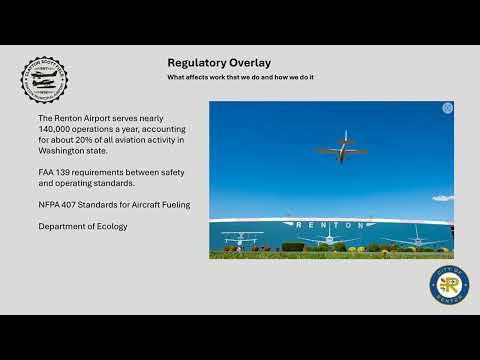
Croats gave a snapshot of airport finances and usage: a beginning balance of $7,400,000, roughly $227,000 in fuel revenue and about $4.7 million in long‑term lease revenue for total revenues of about $4.9 million, with operating costs near $2.5 million. He said the airport supports a mix of general aviation, flight training, corporate flying and some government/military operations and that the field averages "about a 100,000 to a 140,000 operations a year." He added the ADS‑B data showed peak summer days with about 500–530 operations, where "one operation means a takeoff and a landing."
Council members pressed for context. Council member Mark asked whether a recent economic‑impact study exists; Croats said a WSDOT economic‑impact report covering local airports is available but he did not have the figures in front of him and offered to share the file later. "I don't have that in front of me... the last report that was done through WSDOT," Croats said.
On event traffic, Croats said SeaTac and Paine Field are expected to handle most commercial flows for the upcoming World Cup and that local fixed‑base operators were not yet reporting a major uptick in private flights, though the airport would be prepared to receive smaller private aircraft. He confirmed the field is not Part 139‑certified and "if it's a commercial airliner, they have to land at a 139 airport," meaning Renton can accommodate turboprops and light jets but not large airliners.
Croats also described customer‑service and noise‑complaint improvements: a new airport management system and Teams phones that log complaints and create work orders, and a process that has identified and filtered bot complaints to focus staff response on legitimate contacts.
No formal vote or motion was taken during the committee update; the chair thanked Croats and adjourned the meeting. The airport's next procedural steps cited in the presentation included completing the Taxiway Alpha design and contract work, finalizing emergency dredging contracts, and updating leasing rules for committee review around 2026.