Get Full Government Meeting Transcripts, Videos, & Alerts Forever!
Get email alerts on the Budget topic
No spam. Unsubscribe anytime.
Lynnwood mayor presents $145 million biennial budget, proposes restoring 2019 levy rate
Summary
Mayor Christine Frizzell presented the proposed 2025–26 biennial budget showing $145 million in operating revenue and $143 million in operating expenses, proposed restoring the city’s 2019 levy rate (about $84 per household annually) and added positions including a human services coordinator and three maintenance workers for graffiti remediation.
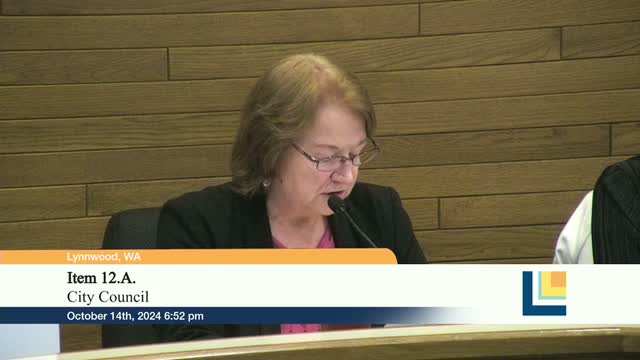
Mayor Christine Frizzell presented Lynnwood’s proposed 2025–26 biennial budget on Oct. 14, saying the plan calls for $145,000,000 in operating revenue and $143,000,000 in operating expenses and asks the council to consider reinstating the city’s 2019 levy rate. “We are asking for them to consider reinstating the amount to the 2019 levy rate,” the mayor said, estimating the change would add about $84 a year to the typical single-family property tax bill (about $7 a month).
The administration described growth in costs driven by added staff, rising insurance, court and IT expenses, and infrastructure replacement. Finance Director Michelle Meyer summarized recent adjustments since the preliminary budget: red-light photo-enforcement revenue previously tracked as an intra-fund transfer was moved directly into fines and forfeitures (increasing that revenue line), and the budget now includes a human services coordinator plus two maintenance-worker positions and one additional maintenance worker for graffiti remediation that Parks proposed.
Council President George Hurst and other members pressed staff on several revenue assumptions. Hurst questioned aggressive sales-tax growth and a large fines-and-forfeitures increase, asking staff to provide supporting analysis. “We need to make sure that we are comfortable with this sales tax forecast,” he said. Staff said the 2025–26 forecast used the Puget Sound regional economic forecaster and noted out-year sales-tax growth assumptions taper off.
The executive office presentation by Assistant City Administrator Julie Moore detailed other budget changes: the council and administration plan to fund an Olympia lobbyist (Brianna Murray, contracted through Gordon Thomas Honeywell Strategies) at $48,000 per year ($96,000 for the biennium) and to reimplement a statistically valid community survey (vendor Polco) at roughly $33,000 for the biennium. Moore also noted major grant awards the city has secured including a $25 million federal infrastructure grant and $10 million from a state transportation package for the Poplar Way project.
Council members asked for clearer metrics tying departmental efforts to measurable outcomes. Council member Decker urged the administration to replace “effort” language with concrete outcomes and cost-benefit measures for items such as a lobbyist contract and new payment/IVR systems, both of which staff said are expected to improve service efficiency. Finance staff noted no major new requests were made for the finance department beyond reallocations, but explained expense increases for audit and Munis financial software licensing were added to the forecast.
Next steps: staff will provide more detail and backup for revenue assumptions and for the largest expenditure changes during the council’s upcoming budget deliberations and departmental presentations. The council will deliberate, may propose amendments, and ultimately must approve the biennial budget before adoption.