Lynnwood Council adopts budget fixes, keeps lower reserve target while staff closes shortfall
Loading...
Summary
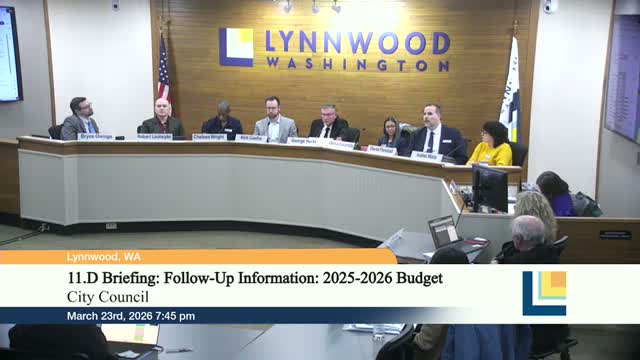
The Lynnwood City Council on May 23 adopted a resolution removing the sunset on a lowered general fund reserve policy and heard staff briefings showing steps that reduced an earlier $25 million budget gap to near zero for 2026, relying partly on a new public safety sales tax and one-time transfers.
Lynnwood's City Council voted unanimously on May 23 to remove the sunset date from a temporary reduction in the city's general fund reserve policy, a move staff said is needed as the city finishes corrective steps that closed a previously reported $25 million budget gap for the 2025-26 biennium.
Director Meyer told the council the $25 million shortfall combined a $3 million beginning balance shortfall with about $22 million in revenue reductions. Council and staff reduced ongoing expenditure commitments by roughly $11-$12 million, used one-time transfers and true-ups, and added revenue measures adopted earlier this year, including a $1 million property tax increase and a rise in utility taxes. The city also expects revenue from a newly adopted 0.1% public safety enhancement sales tax; Meyer said staff conservatively included about $1.75 million for 2026 in the forecast while final 2025 statements are completed.
The council passed Resolution 202606 to remove the end date that would have restored the reserve target to its prior level. Meyer said administrators had moved the target from 2.5 months to 2 months last year to help balance the biennium and that keeping the 2-month target for now allows departments to plan for the 2027-28 budget process.
Council members repeatedly asked for transparency and tracking of the public safety sales tax. Meyer said the ordinance requires the sales tax be placed in a special revenue fund; staff had initially proposed using the police department's existing special revenue fund (Fund 105) to manage implementation for 2026, but the council asked for clear accounting and an individual account/BARS number so residents can trace receipts and expenditures. Meyer said the state will provide an identifiable BARS number for the receipts and staff will create separate accounting to track the funds and bring a budget amendment when money is remitted.
Separately, Meyer explained that some of the balancing actions were one-time moves (for example, approximately $1 million in one-time transfers from Fund 105 and bond/project true-ups) and that continuing structural work is required for 2027 and 2028 because recurring revenues are not expected to grow at the same pace as expenditures. Meyer said departments are identifying an additional $2 million of reductions for 2026 to finalize the plan.
Council President Coelho noted that delaying the public safety sales tax adoption would have required deeper service cuts; Meyer estimated each month's delay could have cost roughly $200,000 in foregone revenue. Councilor Mata reiterated a preference to segregate the funds in a separate special revenue fund for future years to protect the programmatic intent she expected (mental health, reentry, domestic violence services) and to ensure community oversight.
The resolution passed on a 7-0 roll-call vote. Meyer and staff will return with a budget amendment and with monthly reporting showing receipts and proposed uses for the public safety sales tax as those revenues begin arriving.
What's next: staff will finalize 2025 year-end statements, bring a budget amendment to transfer sales tax receipts into the chosen special revenue account and provide periodic reporting to the finance committee and full council.