Get Full Government Meeting Transcripts, Videos, & Alerts Forever!
Get email alerts on the Land Use topic
No spam. Unsubscribe anytime.
Lynnwood holds public hearing on Unified Development Code tweaks as residents warn of parking and enforcement gaps
Summary
City planners presented a package of minor clarifications to the Unified Development Code—ground‑floor commercial thresholds, setback rules and temporary use of shipping containers—while residents warned city leaders about parking, enforcement and potential building‑height impacts near light rail.
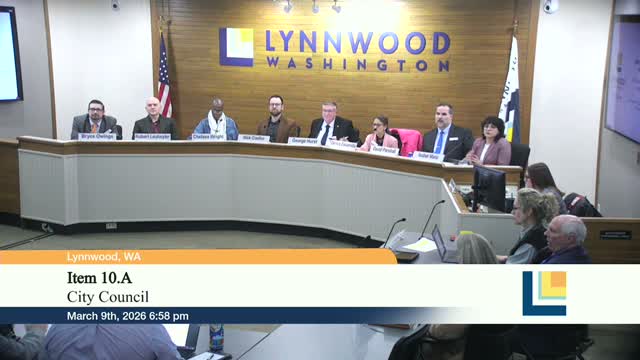
Lynnwood city planners on Monday outlined a set of mainly technical edits to the city’s Unified Development Code intended to clarify how middle‑housing, accessory structures and commercial street frontages will be applied, while several residents urged the council to tighten enforcement and reconsider parking rules.
Community Planning Manager Carl Almgren and planner Zach Spencer told the council the amendments are “trailing updates” to the development code adopted last year and are designed to improve permit clarity and speed. Spencer said the code will continue to require ground‑floor occupiable space in certain zones and that "multifamily structures that are along the street frontage must have a minimum amount of occupiable space, and then 20% of the street frontage edge must be that of a commercial use." The staff presentation also flagged changes to accessory‑structure setback calculations, clarifications about lot coverage and a limited exception allowing temporary commercial shipping containers in commercial zones.
Residents speaking during the public hearing raised a range of concerns. One commenter said the code changes could allow four‑story residential buildings on corners that historically have felt neighborhood‑scale, and asked the council to consult neighbors before approving such changes. Another speaker urged the council to confirm how the city would enforce short‑term commercial containers and cited an example of a shipping container that has apparently remained in a Fred Meyer parking lot for more than 90 days.
"Shipping containers may be used as a building if found to be in compliance with applicable design standards," Almgren said, clarifying that the city’s intent is to permit seasonal, temporary use for commercial businesses while excluding containers that are effectively permanent fixtures.
Council members pressed staff on enforcement capacity and the definition of temporary use. Planner Spencer said the policy does not seek to ban U‑Haul style storage pods used for construction or tenant improvements and that those remain allowed; the shipping‑container provision focuses on containers present longer than 90 days. Carl Almgren told the council that the city’s Development & Business Services department currently funds two full‑time code enforcement officers and favors voluntary compliance followed by targeted enforcement when needed.
Speakers also raised questions about parking minimums, bicycle parking, and how the neighborhood‑commercial zone would interact with nearby residential lots. Staff said the draft updates were meant to strike a balance—promoting walkable street edges near transit while preserving transitions to adjacent residential neighborhoods.
Next steps: staff said the Planning Commission recommended approval on Feb. 12 and that the council will consider the ordinance at a future meeting (staff asked the council to take action at the March 23 business meeting). The public hearing record is now closed and the council has the opportunity to move the draft code forward after deliberations.