Get Full Government Meeting Transcripts, Videos, & Alerts Forever!
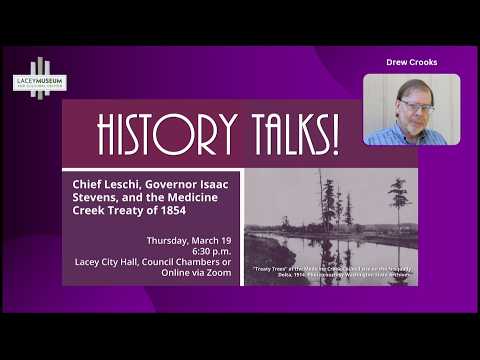
Historian Drew Crooks traces Medicine Creek Treaty, Chief Leschi and the legal legacy for Puget Sound tribes
Summary
At a Lacey Museum history talk, Drew Crooks reviewed the Medicine Creek Treaty of 1854, the disputed role of Chief Leschi and Governor Isaac Stevens, subsequent violence and trials, later reservation changes and the treatylegal legacy for tribal fishing rights.
Drew Crooks, a historian and author, told an audience at the Lacey Museum that the Medicine Creek Treaty of 1854 shaped settlement and tribal law across South Puget Sound and remains central to disputes over land and fishing rights.
Crooks opened by describing mid-19th-century village life in the region and introduced Chief Leschi as a locally respected leader who served as an arbiter within Nisqually communities. He described how U.S. officials, led by Governor Isaac Stevens and aided by George Gibbs, negotiated at Medicine Creek on Dec. 24–26, 1854, and how the council process and its translations were organized. "The great father in Washington D.C. wants the best for you," Crooks said he quoted Stevens as telling the assembled people during the council, highlighting the paternal language used in the negotiations.
The talk emphasized three connected themes: how treaty procedures and translation methods limited understanding among many Native…
Already have an account? Log in
Subscribe to keep reading
Unlock the rest of this article — and every article on Citizen Portal.
- Unlimited articles
- AI-powered breakdowns of topics, speakers, decisions, and budgets
- Instant alerts when your location has a new meeting
- Follow topics and more locations
- 1,000 AI Insights / month, plus AI Chat