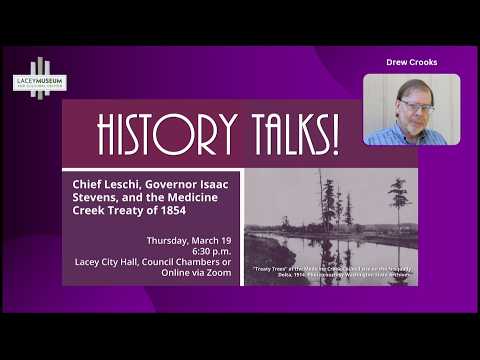
Historian Drew Crooks traces Medicine Creek Treaty, Chief Leschi and the legal legacy for Puget Sound tribes
Loading...
Summary
At a Lacey Museum history talk, Drew Crooks reviewed the Medicine Creek Treaty of 1854, the disputed role of Chief Leschi and Governor Isaac Stevens, subsequent violence and trials, later reservation changes and the treatylegal legacy for tribal fishing rights.
Drew Crooks, a historian and author, told an audience at the Lacey Museum that the Medicine Creek Treaty of 1854 shaped settlement and tribal law across South Puget Sound and remains central to disputes over land and fishing rights.
Crooks opened by describing mid-19th-century village life in the region and introduced Chief Leschi as a locally respected leader who served as an arbiter within Nisqually communities. He described how U.S. officials, led by Governor Isaac Stevens and aided by George Gibbs, negotiated at Medicine Creek on Dec. 24–26, 1854, and how the council process and its translations were organized. "The great father in Washington D.C. wants the best for you," Crooks said he quoted Stevens as telling the assembled people during the council, highlighting the paternal language used in the negotiations.
The talk emphasized three connected themes: how treaty procedures and translation methods limited understanding among many Native participants; what the treaty actually conveyed in land and payments; and the long-term legal consequences. Crooks summarized the treaty as ceding roughly 2,240,000 acres in what became Thurston and neighboring counties in exchange for payments and small reservations. The transcript cites payments of about $32,500 in goods to be distributed over time and describes reservation allotments that the speaker characterized as small and often unsuitable for subsistence.
Crooks recounted that some contemporaneous Native witnesses later told historians that Leschi opposed the treaty—there are oral accounts that he publicly rejected it and tore up an appointment as sub-chief—though Crooks noted those episodes do not appear in the official record and depend on memories recorded decades later. He described the aftermath: rising tensions in 1855, militia orders to arrest Leschi and Klamuth, irregular skirmishes through 1856, and Leschiwas captured, tried (a mistrial followed by a conviction) and executed in February 1858; Crooks said many contemporaries later described the prosecution as "judicial murder."
The lecture also traced later administrative changes: Crooks described Stevens' 1856 adjustments (at Fox Island) that increased the Puyallup allotment to the figure he cited (about 22,000 acres) while the Nisqually reservation boundaries were moved and later reduced, and he noted large 20th-century transfers of reservation land for military use (Camp Lewis/Camp Lewis-related transfers after 1917).
Crooks tied the treaty's fishing provisions to 20th-century struggles. He recounted mid-century curtailment of tribal fishing, the "fish wars," and the legal turn that followed: a 1974 federal decision by Judge Boldt recognizing substantial tribal harvest rights and later U.S. Supreme Court rulings that affirmed tribal shares in subsequent appeals. Crooks argued that the treaty language—short and compact in its original form—ultimately provided a legal foundation for those rights.
Audience questions addressed technical and local-history points: why some reservations appear squared on modern maps (Crooks said later surveys and block-based surveying produced that appearance); Leschi and his half-brothershared a father but different mothers (per Crooks), and where the Leschi monument in Lakewood is sited (Crooks said near a small shopping center). Crooks also cautioned against racialized speculation about origins when an audience member suggested a Central American lineage for the Nisqually.
Crooks closed by urging reflection on how the Medicine Creek Treaty both facilitated settler claims to most regional land and established the reservation system and specific rights (for example, fishing) that have had enduring legal and cultural importance for descendants on all sides.
The Lacey Museum moderated a Q&A session after the talk and provided event and registration details for upcoming programs.