Get Full Government Meeting Transcripts, Videos, & Alerts Forever!
Get email alerts on the Transportation topic
No spam. Unsubscribe anytime.
Regional planner warns Benton City SR‑225 must improve biking and walking to meet new multimodal standard
Summary
Aaron Bridal of the Benton‑Franklin Council of Governments told Benton City council that state MMLOS rules require the city to raise multimodal service on SR‑225 (downtown) from an LTS 3 to LTS 2 or 1, which could mean adding bike facilities or nearby multiuse paths; he outlined funding options and drew questions from residents about parking and safety.
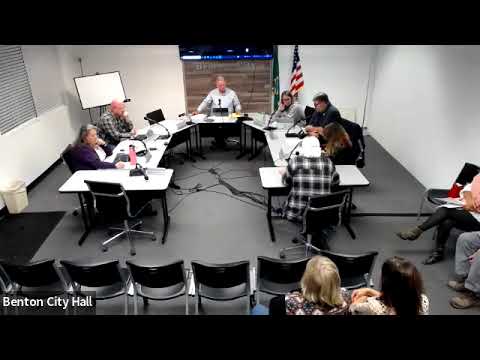
Aaron Bridal, a planner with the Benton‑Franklin Council of Governments, told Benton City council on Oct. 21 that changes to the Growth Management Act and related state guidance require local transportation plans to adopt a multimodal level-of-service (MMLOS) standard that measures cars, active modes, transit and freight.
Bridal said the portion of State Route 225 through downtown is currently a Level of Traffic Stress (LTS) 3 and that WSDOT’s guidance expects the city to raise service on state facilities toward an LTS 2 or 1. "You have to be able to bump up the service on 225 from a 3 to a 2 or a 1," Bridal said, adding that the city could do that by installing bike facilities on the roadway or by building a multiuse pathway within a quarter‑mile as an alternate route.
Bridal noted funding avenues the city could pursue, including the Highway Infrastructure Program (CHiP) cycle and other state solicitations, and said the BFCOG can assist with parking inventories and project packaging. He said he submitted a proposal to Union Pacific for the downtown railroad bridge for slightly under $500,000 and that UP’s real‑estate team had indicated initial support.
During question-and-answer, residents and council members pressed Bridal on whether shifting a bike route to an adjacent street would meet the state requirement and on the effect of different parking configurations. Bridal said the quarter‑mile alternate is meant to reflect a five‑minute walk and that in some cases an adjacent multiuse path could meet MMLOS requirements, but stressed that WSDOT must be closely involved because the downtown corridor is a state facility. "We want to help you fulfill these requirements any way possible," he told council.
Several residents raised safety and practical concerns. Beck Engelhart opposed replacing angled parking with parallel parking, arguing parallel spots would reduce capacity and create congestion during peak periods. Bridal acknowledged angled-to-parallel changes would be a major shift in downtown character and recommended heavy WSDOT involvement and further study.
The presentation and the subsequent public Q&A left council with several follow-ups: staff said they will coordinate with BFCOG and WSDOT, examine parking inventories, and explore grant timing and packaging for potential bicycle/pedestrian and bridge projects. No formal action was taken on the MMLOS recommendations at the meeting.