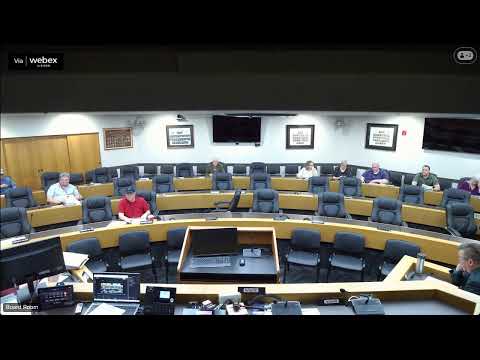
LaSalle County law and justice committee approves routine reports, cites jury-summons delivery problems and moves to executive session
Loading...
Summary
At its March 31 meeting the LaSalle County Law and Justice Committee approved monthly and quarterly reports and bills, reviewed caseload and jail statistics, raised concerns about jury-summons delivery and civic outreach, and voted to enter an executive session to consider a personnel matter under a cited statute.
The LaSalle County Law and Justice Committee met March 31 and approved a series of routine monthly and quarterly reports and departmental bills, heard updates on caseloads and jail population, discussed problems with jury-summons delivery and civic-education outreach, and voted to enter an executive session to discuss a personnel matter.
Greg McCarroll summarized February revenue and caseload activity, saying, "Revenue $202,001.73," and reporting $66,005.52 sent to the agency and February collections of $24,002.08. He told the committee that February was a shorter month for filings and that cases filed in the month totaled 1,008. "Cases filed now February was a little bit shorter month, 18 workdays," he said, and added that overall caseloads remain consistent.
State's Attorney Joe Osipinski updated the committee on homicide caseloads when asked, saying the county had 9 cases at one point, with two unsolved and three recently completed; he said "the next one's coming up next month." The committee approved the state's attorney's report by voice vote.
Susan presented judiciary statistics for LaSalle County, reporting a juvenile active caseload of 86 (administrative caseload 8) and an adult active caseload of 499 (administrative 276). She reported probation fees ordered for the month were $18,300, with $3,108.34 collected in the month and $88,128.35 collected to date for the period cited.
Chuck reviewed quarterly financials and grant receipts, reporting operation service fund expenditures of $4,059.71 for the quarter, circuit court jury expenses of $45,804, and general fund income of $283,007.39. He noted grant receipts, including $50,349.01 for intensive probation and $174,204.11 for a juvenile grant; he said the treatment-alternative court had not received funds this quarter.
Laurie told the committee that courthouse renovations were complete and judges had resumed court upstairs. She also announced that Associate Judge Jans, the traffic judge, is retiring in April and that a selection process is underway.
Trisha reviewed jury summons activity and explained why apparent failure-to-appear numbers can overstate final absences: she reported 1,445 summons issued in March, 629 reminders, two grand‑jury dates and two jury trials, with 133 jurors brought in and 53 failure-to-appear records at the time of printing. She said many later rescheduled, some notices were returned undeliverable and some questionnaires were not returned. "The mail is awful," she said, describing delivery problems that can prevent summonses from reaching recipients. Trisha and Chair Templeton discussed outreach to schools for law‑day and civic education and noted existing mock-trial programs, including an annual mock trial at Ottawa High School.
Jake presented detention-home financials and population figures, reporting monthly bills of $11,408.01 (prepaid $1,614.67) and income items that included a Securus phone system payment of $72.16, a state/federal food subsidy of $1,044.80 and a large state salary reimbursement of $72,144.68; he said income realized to date was $182,125.41 and average daily population so far is 4.
Procedural motions dominated the business portion of the meeting: the committee approved Resolution 23‑53, accepted multiple departmental reports and paid a series of departmental bills and the previous meeting minutes by voice vote. Near the end of the public portion, Amanda moved the committee into executive session citing "I 5 ILCSC 1" to consider appointment, employment, compensation, discipline, performance or dismissal of specific county employees and to hear testimony on a complaint; members approved the motion and a roll call recorded affirmative votes by present members.
The committee adjourned the public portion of the meeting to proceed to the executive session; no citizen comments were recorded during the public meeting.