Get Full Government Meeting Transcripts, Videos, & Alerts Forever!
Get email alerts on the Planning Law topic
No spam. Unsubscribe anytime.
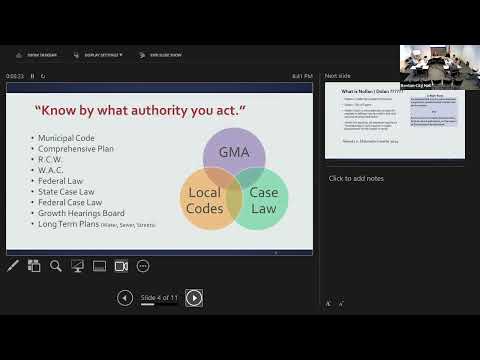
Consultant Steve Zetz tells Benton City planning commission to ‘know by what authority you act’ amid state law changes
Summary
At a training session, consultant Steve Zetz urged Benton City planning commissioners to document the legal basis for land‑use decisions, explained Nolan/Dolan exaction tests and litigation risks (citing Cle Elum), and recommended checklists, findings and legal counsel to reduce exposure.
Steve Zetz, a consultant and former planner, told the Benton City Planning Commission at its regular meeting that commissioners must “know by what authority you act” when deciding land‑use matters, and he outlined legal limits that affect local planning decisions.
Zetz, introduced by a city staff member as a former planner for the city of Prosser and now working as a planner elsewhere, led a training that distinguished legislative actions (broad discretion) from quasi‑judicial decisions (which require written findings). He said the commission’s record becomes the primary evidence if a decision is appealed, and stressed that clean, well‑documented findings and staff reports are the commission’s best defense in litigation.
“Know by what authority you act,” Zetz said, summarizing a recurring theme of the presentation. He walked commissioners through two Supreme Court frameworks—commonly referred to as Nolan and Dolan—that require governments to establish an essential nexus and proportionality before imposing off‑site exactions, such as park dedications or frontage improvements. Zetz used a Tigard, Ore., hardware‑store example and other case law to show how excessive conditions can be struck down as unconstitutional exactions.
Zetz warned that litigation can be costly for small jurisdictions. He cited the Cle Elum litigation as a cautionary example and described how large judgments and delay damages can strain municipal budgets. He advised commissioners to rely on staff, legal counsel and clear code‑based checklists when reviewing subdivisions and other permits.
He recommended a practical approach: require developers to submit traffic‑impact studies when level‑of‑service (LOS) is uncertain, verify water and sewer capacity up front, and use checklists derived from municipal code so the commission reads consistent, code‑based findings into the record. Zetz also urged commissioners to take testimony without soliciting or offering opinions and to disclose conflicts and ex‑parte contacts at the outset of quasi‑judicial hearings.
Zetz said recent state actions will further limit some local controls. He noted that jurisdictions planning under the Growth Management Act will be required to allow accessory dwelling units (ADUs) and described how the new rules narrow certain local parking and lot‑coverage requirements (as stated in the presentation).
Staff and commissioners agreed to start drafting checklists and to coordinate with the city engineer and planning staff so the commission receives complete packets before hearings. The presentation closed with a reminder to consult the city attorney when in doubt.
Note on name spelling: the transcript contains several spellings of the presenter’s surname ("Zets," "Zest," "Zetz"). The commission introduced him to the group as “Steve Zets”; this article uses the normalized spelling "Steve Zetz" for consistency and clarity.