Get Full Government Meeting Transcripts, Videos, & Alerts Forever!
Get email alerts on the Design Review topic
No spam. Unsubscribe anytime.
Design review panel approves canopy and façade updates at 3297 Mount Diablo Boulevard with lighting condition
Summary
The Lafayette Design Review Commission approved updates to the former Svenson's Automotive at 3297 Mount Diablo Boulevard on March 23, 2026, including a new canopy and parapet extension, and required exterior fixtures be relocated under the canopy to avoid triggering Title 24 compliance measures.
The Lafayette Design Review Commission on March 23 approved design updates to 3297 Mount Diablo Boulevard — the former Svenson's Automotive — including a new three-sided parapet extension, a front canopy and a façade repaint, and adopted a resolution finding the project exempt from the California Environmental Quality Act (CEQA).
Project planner Nicole Zittel delivered the staff report, saying the building sits in the C-1 zoning district in the East End commercial area of downtown Lafayette and noted the existing building height of 15 feet 8 inches would rise to 20 feet 1 inch with the parapet extension. She also pointed out that a mural on the side elevation is not a recognized public-art installation and therefore would not trigger public-art review. "My name is Nicole Zittel. I'm the project planner for this design review application, at 3297 Mount Diablo Boulevard," she said.
Property owner Steve Bueller said the scope is intentionally focused on modest aesthetic improvements and necessary roof repairs, explaining parapet work is needed to properly install a TPO roof and to create consistent parapet heights. "I'm Steve Bueller. The property owner," he said, adding that Title 24 compliance can become expensive. "The title 24 would essentially be triggered by anything by remove or replace in kind," Bueller said, describing the owner's concern about the cost and complexity of energy-code engineering and commissioning.
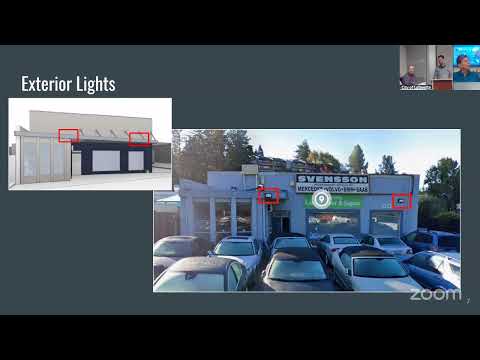
Commission discussion centered on exterior lighting placement because altering or replacing certain fixtures can trigger Title 24 energy-code requirements. Zittel told the commission that county building staff confirmed changing exterior fixtures for new work would trigger Title 24 paperwork; she said replacement "for the new work only" would be subject to those requirements. Commissioners and the applicant discussed options, including leaving fixtures in kind or relocating them beneath the new canopy so they would be less visually prominent and avoid more extensive Title 24 measures.
Commissioner Glenn Cass moved to approve the project with the condition that the exterior light fixtures be moved under the canopy; the chair seconded. The commission recorded two ayes and instructed staff to finalize the findings and adopt the design-review resolution (Resolution 2026-01) approving the project subject to conditions. One letter of support from an adjacent commercial property owner was received by staff and noted in the record. The staff report also noted that existing signage would remain; any new signage or tenant would need to obtain separate sign permits.
The commission's action clears the applicant to proceed toward building and sign permits subject to the conditions in the resolution; staff and the applicant left the meeting wishing the owner luck with the project.