Bangor advisory committee weighs language-access plan after adult-education survey
Loading...
Summary
The Racial Equity, Inclusion and Human Rights Advisory Committee reviewed preliminary staff survey results and heard from Bangor Adult Education and the New Mainers Resource Center on rising demand for English-language services and practical options—such as pay‑per‑use interpretation and pilots using a language line—to improve city access.
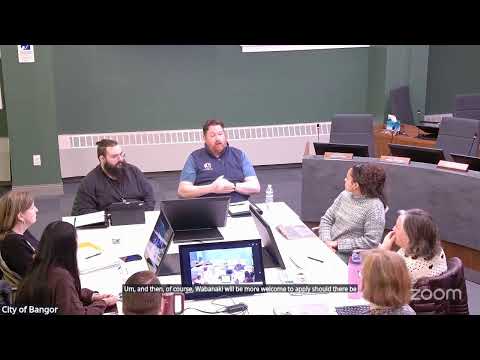
The Racial Equity, Inclusion and Human Rights Advisory Committee spent the bulk of its March meeting reviewing a draft language-access plan and surveying existing community resources.
Assistant City Manager Courtney O'Donnell told the committee an initial staff poll returned roughly 60 responses but noted the city employs more than 400 full-time staff (about 600 including part-time), so a broader sampling is needed to accurately size demand. "Sixty responses is pretty good, but we do have, more than 400 full time employees, nearly over 600, including part time," she said.
Greg Levitt, director of Bangor Adult Education, reported growing demand for English-as-a-second-language instruction: "Year to date from July 1, we've had 114 individuals seek our services," he said, describing rolling enrollment and a full-time ESL teacher. Brian Loring of the New Mainers Resource Center outlined the center's role helping internationally trained professionals with credentialing and workforce access and said adult education is a "gateway into a lot of workforce development opportunities."
Committee members and guests identified Spanish, Mandarin and French (and American Sign Language for some interactions) among the most common language barriers cited in staff feedback. The group discussed tools in current use—including Google Translate and ad hoc phone apps—and weighed options that pair human interpreters with faster access, such as LanguageLine's pay‑per‑minute phone and video interpreting services. One participant noted LanguageLine advertises audio interpreting at about $3.95 per minute and video interpreting at about $4.95 per minute, billed only for minutes used, including 24/7 emergency video interpreting for public-safety situations.
Councilor Michael Beck framed the question in terms of efficiency: he asked how much staff time might be saved at service counters and whether paying per minute could shorten in-person interactions that otherwise take much longer when translated ad hoc. "If it's $3.95 a minute rather than taking 20 minutes on Google Translate when it could be a 5–7 minute conversation on the phone, that extra money...is a benefit to everyone," he said.
The committee did not choose a single solution but identified next steps: Courtney O'Donnell will circulate the draft language-access plan for more departmental feedback, solicit additional survey responses to better identify high-need interaction points (for example, counter service versus public-safety responses), consult public-safety about interpretation needs, gather cost estimates, and explore a pilot of an interpreted phone/video service to test accuracy and responsiveness before committing to a broader rollout.
Why it matters: Committee members said clearer, faster access to interpretation could reduce mistakes in high-stakes interactions (taxes, benefits, emergency response) and improve customer service and equity for New Mainers and other residents with limited English proficiency. The committee plans follow-up reporting from staff on pilot feasibility and cost estimates at a future meeting.