Get AI Briefings, Transcripts & Alerts on Local & National Government Meetings — Forever.
Benton City planning panel hears neighbors’ drainage and flood concerns on proposed 46‑lot subdivision
Loading...
Summary
The Planning Commission held a preliminary hearing on a proposed 4.41‑acre single‑family subdivision. Staff recommended approval with mitigation and a condition for a durable perimeter fence; residents pressed the applicant and staff on drainage, wetlands relocation, flood risk and easement impacts.
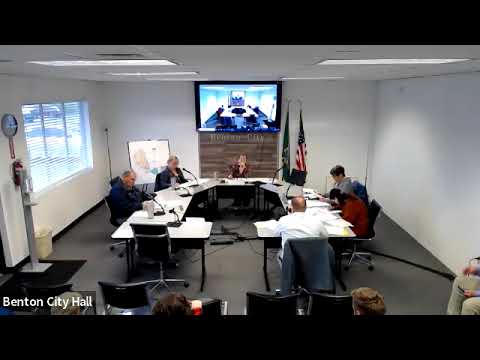
The Benton City Planning Commission on April 1 heard more than an hour of public testimony and technical back‑and‑forth about a proposed 4.41‑acre single‑family subdivision that staff said would create roughly 20–46 lots and extend water and sewer to each lot.
Staff opened the public hearing by describing the preliminary‑plat process and the record, telling commissioners the staff report contains the findings of fact and that technical issues would be addressed in later civil review and in state reviews where applicable. Robert McLeod, the applicant’s representative with Canadian Engineering, described the proposal and said the project does not seek variances to street or utility standards and will follow city public‑works specifications.
Why it matters: neighbors repeatedly told the commission they worry the development will worsen local drainage and flooding, alter wildlife habitat and increase traffic and noise; staff said state and city mitigation measures and civil engineering review will guide grading, utilities and any wetland relocation.
Residents and former meeting chairs said they want inspection and verification that drainage promised during prior approvals has been built. “We have a serious drainage issue,” Michelle McLeod, a Benton City resident who said she chaired an earlier meeting about 11th Street, told the commission, asking staff and the applicant to inspect a recent contractor’s work that she said routes water into open ditches rather than the agreed catch basin.
The applicant responded that the site contains low‑quality (category 4) wetlands and that licensed consultants and Department of Ecology staff have been involved in preparing a wetlands mitigation plan. “What’s presented before you is a single family residential subdivision,” Robert McLeod said, describing plans to relocate and recreate wetlands on‑site (labeled Track A on the plat), then surround the wetland with a public park amenity to be maintained by the HOA.
Technical issues raised: residents and commissioners pressed on three technical areas that will be resolved later in the permit process: - Wetlands and hydrology: staff and the applicant said geotechnical reports and groundwater monitoring were done and that the wetlands are groundwater‑fed rather than surface water from the river; any relocation plan must meet Department of Ecology mitigation standards. Staff said relocation is uncommon but not unprecedented if Ecology approves the mitigation plan. - Utilities and sewer alignment: the applicant said an existing pressurized main and a diagonal gravity sewer cross the parcel; plans call for rerouting conflicting mains under proposed streets as part of civil design and coordination with utility locates. - Floodplain and grading: staff explained floodplain construction standards including required elevation and foundation venting/equalization; staff said grading must be designed so floodplain elevations are not pushed onto neighboring properties.
Easements, access and neighborhood impacts: several nearby residents described an existing irrigation main and private easement that serves adjacent properties and asked how their access and water service will be protected. One resident who identified himself as Gary recounted flooding in 1996, concerns about wildlife and an overall preference to retain rural character; another speaker identified an easement that currently provides vehicle access to landlocked property and asked that the easement be preserved or negotiated during final plat and civil review.
Action and outcome: staff concluded by recommending approval of the preliminary plat based on the findings in the staff report and the mitigated determination of non‑significance, and asked whether the commission wanted to condition the recommendation. Commissioners signaled consensus to forward a recommendation of approval to city council that includes a condition to require a durable fence or barrier on the east perimeter to separate the new subdivision from adjacent rural properties. The transcript does not record a formal roll‑call vote on that recommendation; staff said the recommendation and any proposed condition would be considered by the City Council.
What’s next: the applicant must finalize civil plans, utility relocations and a formal wetlands mitigation plan for Department of Ecology review; easements and access issues raised by neighbors will need resolution during final plat and utility coordination. The staff record and the mitigated determination of non‑significance will accompany the material forwarded to council.