Get Full Government Meeting Transcripts, Videos, & Alerts Forever!
Get email alerts on the Infrastructure Funding topic
No spam. Unsubscribe anytime.
Puyallup council votes to advance traffic-impact-fee overhaul, moves to adopt $8,762 maximum defensible fee on first reading
Summary
After an extended staff presentation and council debate, the council approved first-reading direction to adopt a new traffic-impact-fee ordinance: set a maximum defensible fee of $8,762 per single-family-equivalent, index fees to the construction-cost index, allow up-to-80% reductions for qualifying affordable-housing units and early-learning centers, add a 50% heavy-truck trip premium for industrial uses, and set a land-use credit look-back policy (5 years, up to 10 by director discretion).
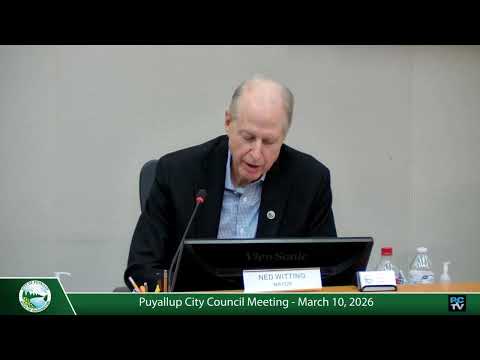
Puyallup City Council on March 10 advanced a major update to the city's traffic-impact-fee ordinance on first reading after an extended staff presentation and multiple straw votes on individual components.
City Engineer Hans Unger and consultant Daniel Dye outlined the study supporting a higher fee to address capacity projects (sidewalks, intersection work, road widening and related capital needs). The current nominal fee ($4,500 per single-family equivalent, unchanged since 2007) was presented alongside two implementation options: a phased catch-up approach and an immediate increase to the study's maximum defensible rate.
After discussion, Deputy Mayor Johnson moved and the council approved a motion to adopt the maximum defensible fee of $8,762 for the ordinance as it goes forward to second reading and public hearing. Council also voted to tie adopted fees to an annual construction-cost index used in the study and to pursue exemptions allowed by state law for certain land uses.
Key components the council approved or directed staff to implement in ordinance language for second reading:
- Fee level: pursue the study's maximum defensible per-unit fee of $8,762 (motion passed). - Indexing: tie fees to the construction-cost index so rates adjust annually (motion passed). - Exemptions: exercise state-allowed authority to provide up-to-80% fee reductions for qualifying affordable housing units and early-learning facilities; staff and the city attorney will draft definitions and affordability-duration conditions (motion passed in concept). - Truck adjustment: apply a 50% heavy-truck trip premium for industrial land uses when calculating impact-fee liability to reflect larger roadway impacts (motion passed). - Credit for prior land use: allow applicants to claim credit for recent preexisting trips when calculating net new trips; council set a look-back baseline of five years with Permitting Services Director and City Engineer discretion to grant credits up to 10 years in extenuating circumstances (motion passed). - Reciprocal fees: staff received direction to explore county-level reciprocal traffic-fee arrangements and return with possibilities (head nod consensus). - Payment/deferral policy: staff and the city attorney explained current state law allows applicants to defer impact-fee payments up to 18 months. Council agreed that if a developer pays early they would lock in the rate at payment; if fees are deferred the payment should be at the rate in effect when payment is made (staff to refine code language to implement).
Council members emphasized competing priorities: raising fees to "let growth pay for growth" and fund sidewalks and safety projects, while being mindful of housing affordability and potential impacts on development economics. Several members urged mitigating steps, including targeted exemptions and careful drafting so large low-income projects still provide required mitigation where needed.
The council passed an omnibus first-reading motion to bring the ordinance back for second reading and public hearing incorporating these components. Staff will return with precise code language, payment and vesting details, and options for any affordability-duration covenants tied to reduced fees.
Votes and procedure: several individual motions and voice votes were recorded throughout the discussion; the first-reading omnibus motion passed by voice vote. Where voice votes were used, staff will include roll-call tallies if required for the second reading.
Ending: The council's direction advances a package that would significantly increase developer-level fees and create a set of programmatic exemptions and operational rules; the ordinance will be refined and scheduled for a second reading and public hearing at a future meeting.
Representative quotes: "We should at least get caught up; growth should pay for growth," Deputy Mayor Johnson said. "Two zones appears to be a simpler option," Senior Planner Kendall Walls said during a separate zoning item.
Speakers quoted (roles as recorded): City Engineer Hans Unger; consultant Daniel Dye; Deputy Mayor Johnson; City Attorney Beck.
Next steps: staff to draft final ordinance language, address payment/deferral mechanics, and return for a second reading and public hearing.