Laguna Beach Council approves removal of four public trees, directs broader urban-forest planning
Loading...
Summary
The council voted to remove a Torrey pine and three other public trees after arborists reported untreatable disease and structural risk, and directed staff to run a public-notice replacement process and develop an urban-forest plan that balances safety, canopy goals and species selection.
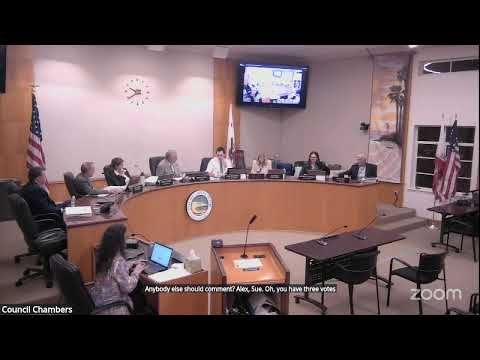
Laguna Beach — The city council voted unanimously to remove four public trees and authorized staff to begin replacement planting under the city’s public-tree policy, citing health and public-safety concerns raised by the city arborist.
Matthew Barker, the city arborist, told the council that laboratory testing and diagnostic imaging showed the Torrey pine at Festival of Arts has “between 80 and 90 percent mortality” and is affected by phytophthora root rot and a newly emerged canker. Barker said those conditions leave no viable treatment options and that removal is the safest management approach to reduce risk to the nearby tennis courts and pedestrian areas.
Reza Jafari, deputy director of Public Works and Utilities, described two additional recommended removals: mature Ficus trees along Short Street whose aggressive surface roots are damaging the asphalt, concrete and sidewalk and interfering with adjacent private improvements. Jafari said removal would allow reconstruction of the sidewalk and roadway to meet ADA standards and prevent recurring root damage.
After hearing more than two hours of public comment — including calls to preserve large trees where possible and concerns about increasing hardscape and losing canopy — the council voted to uphold staff recommendations. The adopted actions authorize replacement plantings; species and final locations will be determined through the city’s public-notice process. Council members stressed they expect replacements to be chosen with an eye toward canopy and fire-safety considerations.
The council also voted to remove a large carob tree in the public right-of-way at 264 Legion Street. City arborist testing using sonic tomography and resistograph tools showed extensive peripheral sapwood decay concentrated on the side leaning over the roadway; staff concluded the structural risk exceeded acceptable thresholds and recommended removal and replacement with a Western redbud in the Catalina roundabout. The council directed staff to identify a nearby site for a larger shade tree to replace lost canopy.
Council members said their votes balanced preservation goals with public safety. “Public safety is the most important role of local government,” one council member said during debate, while others urged a stronger long-term program to grow the city’s canopy and improve tree maintenance.
Council requested that staff return with a schedule and funding options for an urban-forest master plan and tree-inventory work that will: document existing public trees; identify priority planting locations; set targets for large, medium and small planting mixes; and establish criteria that factor site constraints, utilities, ADA compliance and fire-risk where appropriate.
What comes next: Public Works will post removal and replanting notices and complete CEQA notices where required. Replacement species will be selected using the city’s Landscape & Scenic Highways guidelines, adjusted as needed for fire-safety and canopy goals and subject to the public-notice period.