Get Full Government Meeting Transcripts, Videos, & Alerts Forever!
Get email alerts on the Arpa Cameras topic
No spam. Unsubscribe anytime.
El Cajon council reallocates $67,853 in leftover ARPA funds to expand automated license-plate cameras
Summary
The El Cajon City Council voted unanimously to reallocate $67,853 in unused American Rescue Plan Act funds from a business facade grant to buy 40 additional Flock automated license-plate-reader cameras, a move councilmembers said would protect the general fund but drew debate over alternate uses for the money.
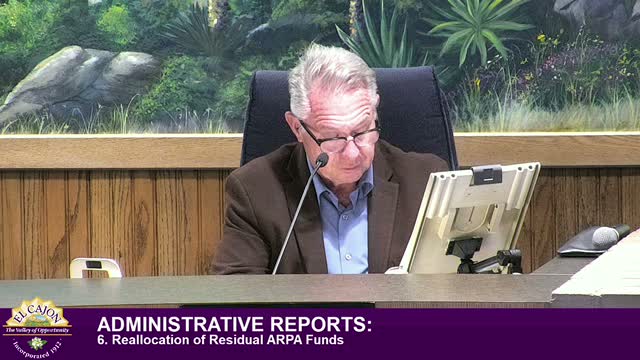
The El Cajon City Council voted unanimously to reallocate $67,853 in residual American Rescue Plan Act (ARPA) funds from the city’s business facade grant program to the city’s automated license-plate-reader camera program.
Ryan Villegas, senior management analyst in the city manager’s office, told the council the business facade program was originally funded at $1,000,000 and reimbursed $932,147, leaving $67,853 in uncommitted funds. Villegas recommended moving those residual dollars from ARP-21 (business facade grants) to ARP-17 (the street camera system) to purchase 40 additional Flock Safety cameras and thereby obligate the ARPA funds before the federal deadline.
“Applying the $67,853 to this purchase would both backfill the general fund and obligate the funds immediately,” Villegas said, noting the camera contract is for $164,750 and the police department is already planning to cover the balance.
Councilmembers pressed staff for operational details. Graham (staff) and Villegas said adding 40 cameras would roughly double the city’s current fleet (staff said there are about 40 now, which would bring the total to roughly 80). Staff reported an ongoing license fee of $3,000 per camera per month, which they said equates to about $147,000 per year and is accounted for in the police department’s existing budget.
Villegas also reviewed the program’s results to date: the city contracted with Flock Safety, installed cameras in July and launched the program in August; staff reported 128 stolen vehicles were recovered and 151 related arrests in the program’s first year. The transcript reports a recovered-total figure of “1,200,000” without specifying units or whether that is a dollar amount.
Some councilmembers urged considering other uses for the leftover ARPA dollars. One member proposed setting aside $15,000 for St. Paul PACE Center window shades and $4,500 for equipment for Amicus’s cabin project. Staff and other councilmembers raised procedural and fairness concerns: Graham cautioned that Amicus does not yet have approval to expand its footprint and that the council could not simply grant money outside an existing program; another councilmember warned about perceptions of favoritism if a narrowly tailored award were made.
After extended debate over timing, eligibility and fairness, the councilmember who proposed the alternate allocations withdrew those requests and moved to approve staff’s recommendation to reallocate the $67,853 to the Flock camera program. The motion carried by unanimous vote of those present.
The council received no public speaker cards for the item. The action obligates the remaining ARPA balance to the camera purchase prior to the federal ARPA obligation deadline cited by staff.