Get Full Government Meeting Transcripts, Videos, & Alerts Forever!
Get email alerts on the Homelessness topic
No spam. Unsubscribe anytime.
Carlsbad council discusses new enforcement and service options after Supreme Court ruling; staff to take proposals to Housing Commission
Summary
Councilmembers and staff debated enforcement tools, vehicle-sleeping limits and expanded shelter options after the Supreme Court's Grants Pass decision; staff listed nine options and will present analyses and cost estimates to the Housing Commission this fall.
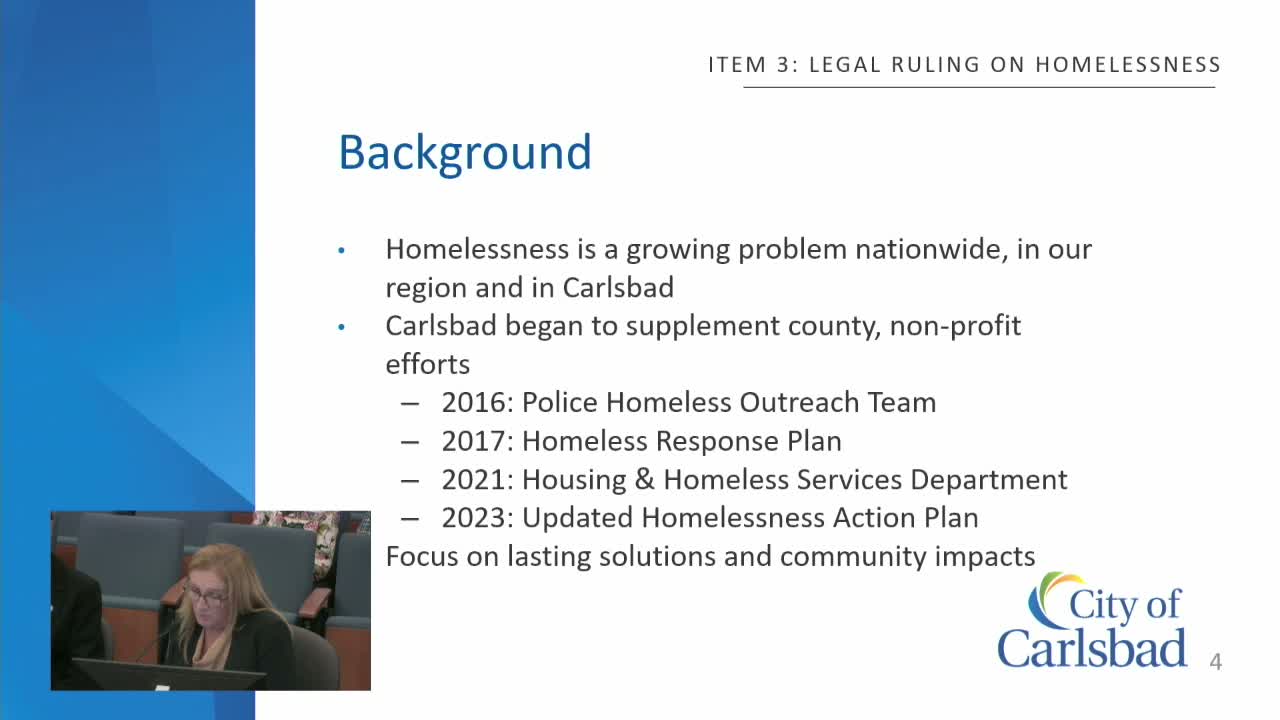
Carlsbad city staff briefed the City Council on policy options for addressing encampments after the U.S. Supreme Court's decision in City of Grants Pass v. Johnson overturned the earlier Martin v. Boise standard. The council heard a staff presentation explaining legal implications, a video of outreach work and public comment urging either more services or stronger enforcement.
The presentation, led by Mandy Mills, director of housing and homeless services, and Allegra Frost, senior assistant city attorney, said the Supreme Court's decision removed a constitutional requirement that an offer of shelter be available before a city may enforce public-camping rules. Frost said the council may choose to retain the current municipal-code language (Carlsbad Municipal Code section 8.3603) requiring an offer of shelter or to remove it and instead codify shelter-offer practices as a best practice outside the code.
Why it matters: the ruling changes the legal landscape for cities nationwide and gives local governments broader discretion to adopt or tighten ordinances that address public camping, vehicle-sleeping, and time-limited restrictions. Councilmembers pressed staff on likely unintended consequences, including displacement into neighborhoods, and asked for cost estimates and staffing needs before adopting new ordinances.
Staff emphasized a two-pronged approach that combines outreach and services with targeted enforcement to address illegal behavior and public-safety concerns. Police Chief Christy Calderwood described the department's "clearance with support" approach aligned to the governor's executive order and regional task-force practices: teams give a minimum 48-hour notice (often 3— days) before a clearance, offer services, and use enforcement only when services are refused or unlawful activity occurs. Chief Calderwood reported that during fiscal year 23—24 the city cleaned up 40 encampments over 135 days and removed just over 151 cubic yards of trash; over the same period the department logged about 1,060 official actions related to people experiencing homelessness, including 114 citations and five arrests.
Public commenters were sharply divided. Rebecca Nussbaum, chief program officer at Community Resource Center, urged the council to prioritize housing and supportive services and avoid criminalization: "Criminalization strategies such as encampment evictions and punitive measures are not only costly but have repeatedly been shown to be ineffective." By contrast, Terry Jacobs urged the city to "revert back to our ban," said neighborhoods are being affected, and requested a memorandum of understanding with NCTD to address sleeping at the train station.
Councilmembers asked detailed questions about accelerating items already in the city's homelessness action plan, whether any option would jump-start a vehicular-homelessness plan, how to avoid simply moving people to other jurisdictions, and how to expand shelter capacity for women and children. Staff said the city has one main shelter partner (La Posada) that hovers around 85'90% occupancy and that adding beds or new facilities is a long-term effort; staff also said safe-parking and other interim measures have long waiting lists.
Next steps: staff will present the nine options (with lettered variations) to the Housing Commission this fall for feedback and return to council with analysis and cost estimates. Councilmembers requested that staff include midyear budget implications if new actions require additional funding or personnel.
The council did not adopt new ordinances tonight; it directed staff to pursue Housing Commission input and to provide the fiscal and implementation details that would be needed before any legislative change.