Get Full Government Meeting Transcripts, Videos, & Alerts Forever!
Get email alerts on the Measure N topic
No spam. Unsubscribe anytime.
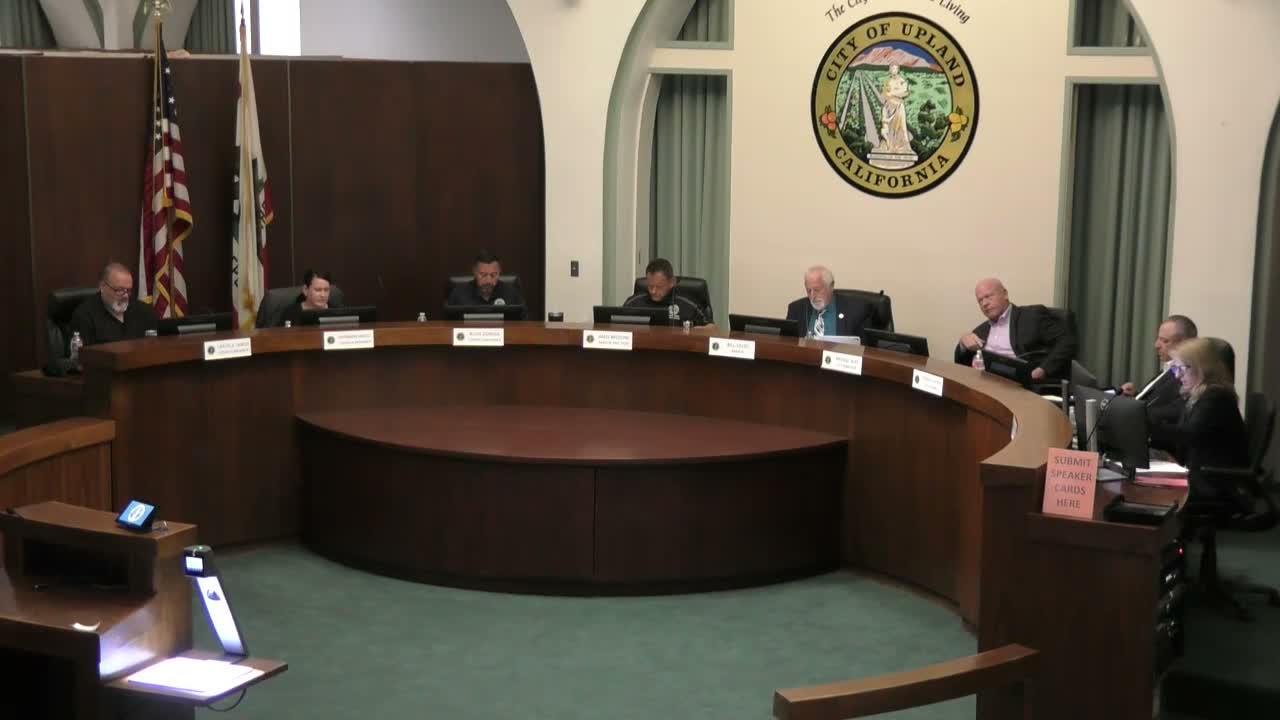
Upland council adopts nonbinding Measure N spending priorities after public debate
Summary
The Upland City Council voted unanimously Sept. 9 to adopt a nonbinding resolution listing priorities for Measure N, a proposed transaction-and-use tax; supporters said it would fund radios, records systems and public safety programs, while opponents warned revenues would flow to the general fund and criticized campaign messaging.
The Upland City Council on Sept. 9 adopted a nonbinding resolution that lays out how the city would prioritize spending if voters approve Measure N, a proposed transaction-and-use tax intended to raise revenue for infrastructure and public safety.
Assistant City Manager Steven Parker told the council the city's pavement management report shows a need of almost $25,000,000 a year for five years to restore pavement condition, while the city currently has less than $10,000,000 a year in restricted funds dedicated to that work. Parker said the resolution is intended to reflect council priorities — first public infrastructure, secondarily public safety — but it is not binding on future councils. He said Measure N proceeds would be general fund revenue; the city would establish a separate reporting fund and publish seven years of spending data on the city's financial transparency website if the measure passes.
Residents who spoke during public comment urged caution. Lois Sikking said the materials accompanying the proposal were "misleading" and appeared to be promotional, arguing the glossy outreach favored a yes vote and that general-fund measures lack project-by-project guarantees. "Do not be deceived," she said, urging the council to reject the resolution. Chris Robles warned that general-fund taxes are vulnerable to repurposing and cited a nearby city's experience, saying "the truth and the reality is the money goes to the general fund." Maria Galvan also urged the council to vote no.
By contrast, Gabe Garcia, president of the Upland Police Officers Association, urged support for Measure N as an investment in public safety. Garcia outlined equipment shortfalls the association says exist, citing an estimated $1,300,000 for updated radios and about $1,200,000 for a new computer-aided dispatch and records system, and said Measure N funds would also support cameras, neighborhood patrols and officer wellness programs.
Council discussion centered on priorities and transparency. Multiple council members said they favor prioritizing infrastructure and public safety, and asked staff to return with possible citizen oversight language; Parker said the ballot measure itself does not require an oversight committee but the council could create one by resolution. After discussion, Council Member Mauss moved to adopt the resolution and the motion was seconded; the council voted to approve the nonbinding priorities unanimously.
The resolution does not change the ballot language for Measure N or legally restrict how future councils could spend general-fund revenue. Council and staff emphasized that the city would create a separate reporting fund to show Measure N receipts and expenditures should the tax pass. The council did not place the tax on the ballot at this meeting; it adopted only the advisory spending priorities resolution.
What happens next: the resolution will appear in the council docket and staff said the city can return with proposed oversight language if the council desires. The next regular council meeting is Sept. 23, 2024.