Get Full Government Meeting Transcripts, Videos, & Alerts Forever!
Get email alerts on the Development Parking topic
No spam. Unsubscribe anytime.
Council approves Grand Hope medical office with reduced EV mandate and some standard parking
Summary
Council approved the Grand Hope Medical office project (10,671 sq ft, three tenant spaces) after staff explained state law limits on parking minimums near transit; the Planning Commission and council agreed on a compromise parking plan (4 EV, 1 ADA, 3 standard stalls) instead of the applicant’s proposed 8 EV spaces.
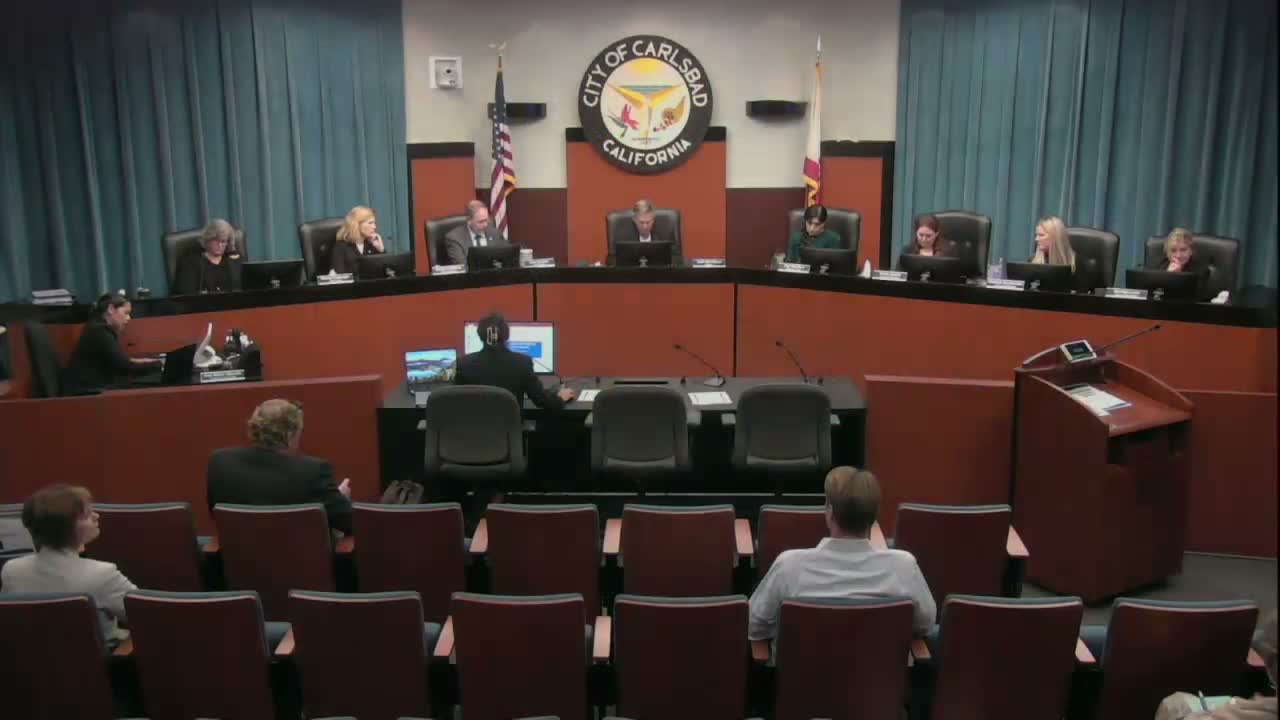
The City Council approved the Grand Hope Medical office project at the corner of Grand Avenue and Hope Avenue after a presentation from associate planner Lauren Zayia Zagiri and questions from council members about parking and patient turnover.
The project proposes demolition of an existing single‑story medical office and construction of a two‑story, 10,671‑square‑foot medical office building with three tenant spaces and a one‑story parking garage. Staff said state law (AB 2097, effective January 2023) restricts local minimum parking requirements for projects within a half‑mile of public transit; the site is within a half‑mile of the Carlsbad Village Train Station. Under the city’s former parking ratio (1 space per 355 sq ft), the building would have required 23 spaces, but AB 2097 limits that authority and allows the city to require only EV and ADA spaces tied to what would otherwise have been required.
The applicant initially proposed eight electric‑vehicle (EV) stalls (including the ADA stall) as a public‑benefit deviation to building massing standards. At the Planning Commission hearing, commissioners expressed concern about tight parking in the village and voted to approve the project with a revised parking condition: four EV stalls, one ADA stall and three standard stalls for gas‑powered vehicles (a total of eight on‑site stalls). Councilmembers questioned the applicant about expected patient turnover and whether stalls would be pooled between tenants; the applicant said the owner (a dentist) plans to make the stalls available to all tenants.
Councilmembers acknowledged parking was the primary community concern but thanked staff and the Planning Commission for balancing climate goals and practical parking needs; the council moved to adopt the resolution approving the project, and the motion passed unanimously.
Why this matters: The decision illustrates how AB 2097 constrains local parking requirements near transit and how councils and planning commissions negotiate tradeoffs between EV infrastructure and practical parking availability for businesses and patients.
Next steps: The council approved the project; implementation details (tenant assignments and on‑site parking distribution) are to be managed by the property owner and building management.