Get Full Government Meeting Transcripts, Videos, & Alerts Forever!
Get email alerts on the Development Impact Fees topic
No spam. Unsubscribe anytime.
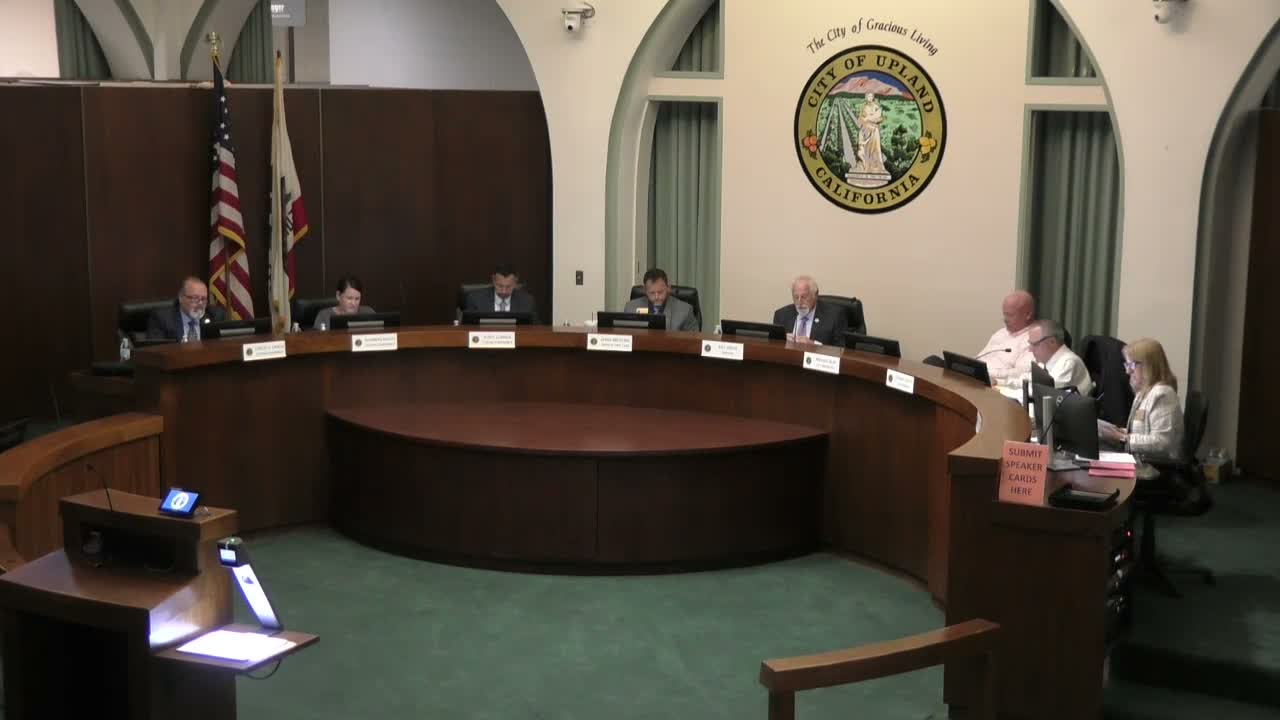
Upland council adopts updated development impact (Nexus) study and Quimby fee schedule after public hearing
Summary
After a public hearing and consultant presentation, the Upland City Council voted unanimously to adopt a new development impact fee Nexus study and updated public facilities and Quimby fee schedules, which reflect AB 1600/AB 602 rules and per-square-foot residential fees given the city's near build-out status.
The Upland City Council voted unanimously to adopt a development impact fee Nexus study and to approve updated public facilities and Quimby fee schedules following a public hearing and consultant presentation. The study, prepared with consultant DTA and presented by Richard Reese (speaker 4) and staff, recalculates fees under current state rules (AB 1600 and changes from AB 602) and reflects that Upland is approximately 95% built out.
Richard Reese explained that, under recent state guidance, residential fees must generally be charged on a per-square-foot basis rather than per unit unless a defensible alternative is demonstrated. "Development impact fees are implemented ... to offset that extra strain," Reese said, describing the methodology that ties fee amounts to level-of-service and plan-based calculations. He told the council the figures in the report represent the maximum legally defensible fees the city could charge under current law and that the city could elect to charge less.
During the public hearing, Natasha Walton (speaker 19) of People for Upland Parks urged the council to reconsider certain Quimby land-cost inputs and not reduce park-related fees: "I'm just encouraging you to reevaluate this, look at this report a little bit more closely," she said, noting concerns that lower fees could limit the city's ability to buy or develop parkland such as Sycamore Park. Staff and the consultant responded that the study uses current land-cost and Department of Finance population inputs and that the proposed fees are the maximum allowed under the law; council members asked for clarifying points about the person-per-household calculations behind the Quimby fees.
Councilmember Garcey moved to adopt a resolution approving the Nexus study; Councilmember Zuniga seconded and the motion passed unanimously. A separate vote to adopt the updated public facilities development impact fee schedule and Quimby fee schedule (moved by Councilmember Garcia and seconded by the Mayor Pro Tem) also passed unanimously.
Why it matters: the updated fees determine the maximum development-related charges the city can impose on new construction to pay for new infrastructure. Because Upland is largely built out, some fees in the study declined compared with the pre-2006 schedule; staff and the consultant said that outcome is consistent with the legal methodology and prevailing demographics.
The council adopted an annual cost escalator tied to the California Construction Cost Index as part of the package and closed the public hearing.