Get Full Government Meeting Transcripts, Videos, & Alerts Forever!
Get email alerts on the Planning Commission Training topic
No spam. Unsubscribe anytime.
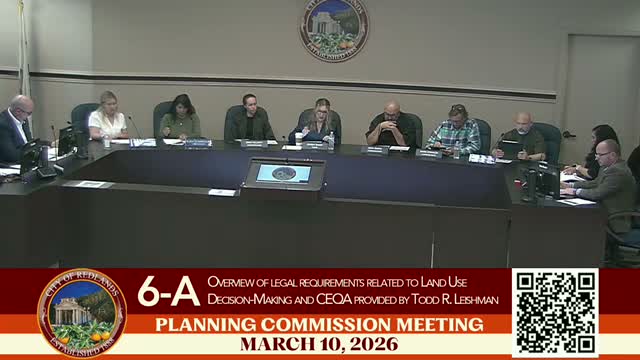
Redlands Planning Commission gets CEQA, findings and conflict-of-interest refresher from special counsel Todd Leishman
Summary
Special counsel Todd Leishman led a March 10 workshop for the Redlands Planning Commission on CEQA practice, how to make defensible findings, disclosing ex parte contacts and the Nolan/Dolan nexus and proportionality rules for conditions of approval.
The Redlands Planning Commission received a legal workshop on March 10, 2026, focused on the commission’s role in land-use decisions and how to apply California Environmental Quality Act standards, the commission was told by Todd Leishman of Best Best & Krieger.
Leishman, the presenter, told commissioners that the body often wears two different hats: a quasi‑judicial role when deciding conditional use permits and variances — where members must act like judges — and an advisory or legislative role when recommending general‑plan or zoning changes to the City Council. "Your job is to advise," he said, "and when you sit as a judge . . . you need to have an open mind and not make public statements that show you’ve already decided." (Todd Leishman, special counsel)
Why it matters: The distinction affects what commissioners can and cannot consider before a hearing, how they must report ex parte contacts, and the legal standard by which their decisions are reviewed. Leishman highlighted that undisclosed communications or introducing independent evidence can expose a decision to reversal as a prejudicial abuse of discretion.
On ex parte communications, Leishman advised transparency. "If you have had any ex parte communications . . . you need to announce that," he said, adding that the disclosure should end with a statement that the member "never made up my mind." Yvette Garcia, the city attorney, reinforced the point with an example where a commissioner who rallied neighbors was advised to step off the dais. (Yvette Garcia, City Attorney)
A major portion of the presentation covered findings — the written facts that must support approvals or denials. Leishman emphasized factual, specific findings rather than conclusory language. "Do the math out loud," he said, giving an example: cite the exact code section, the project's measured height and the maximum permitted height, and then state the inconsistency. He warned that a single missing required finding can force a denial; conversely, a conclusory finding risks reversal on appeal.
Commissioners asked how to weigh technical evidence such as traffic studies. Leishman and staff said both expert and anecdotal evidence can be considered but that overturning an expert study generally requires additional technical analysis or peer review. Staff advised commissioners to bring technical questions to staff before meetings so consultants can vet them.
On conditions of approval Leishman explained the Nolan/Dolan framework: conditions must have an "essential nexus" to the impact and be "roughly proportional" in scope. He used common examples (lane widening for traffic impacts versus an unrelated dog park) to show permissible and impermissible exactions.
Leishman also reviewed CEQA practice: thresholds of significance, when an environmental impact report is warranted, and the limits on using CEQA to deny projects for subjective reasons such as aesthetics. He cautioned that projects are typically judged against the rules in effect when an applicant submitted a complete application and that legislative changes made afterward generally do not apply retroactively.
City Attorney Garcia added practical advice on conflict-of-interest and recusal: if a commissioner has a financial interest they should disclose it and step down, including leaving the room if necessary, and they may testify as a member of the public for the standard three minutes.
No action was required for the workshop. Commissioners thanked the presenters and asked staff to circulate related materials and maps referenced during the presentation.
The commission will next meet on March 24, 2026.