Get Full Government Meeting Transcripts, Videos, & Alerts Forever!
Get email alerts on the Land Use Development topic
No spam. Unsubscribe anytime.
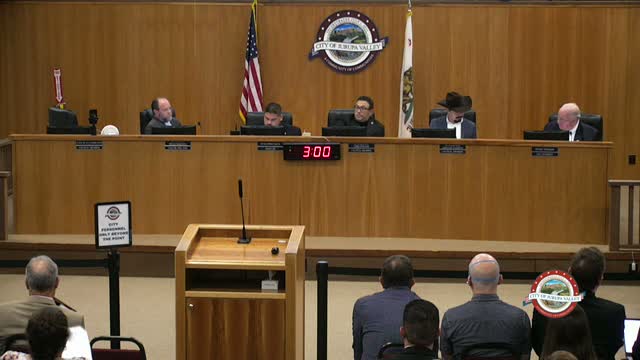
Jurupa Valley council introduces Rio Vista development-agreement ordinance after heated public hearing over ancient oak
Summary
After hours of public testimony both defending and decrying the Rio Vista Specific Plan, the Jurupa Valley City Council introduced the development‑agreement ordinance and adopted related resolutions with changes including earlier park‑build triggers and clarified DA language; critics pressed for independent scientific review to ensure protection of the ancient Palmer (Jurupa) Oak.
Jurupa Valley — After more than four hours of public testimony and technical questioning, the City Council introduced an ordinance to approve the development agreement for the Rio Vista Specific Plan and adopted related resolutions with staff‑ and applicant‑proposed tweaks, while several council members said they still had unanswered questions about the plan’s potential environmental impacts.
The project, proposed by Richland Communities, would replace a 1992 specific plan and permit a mix of uses that staff described as up to 1,697 residential units, roughly 1.27 million square feet of light‑industrial land, a business‑park component, 510.8 acres of natural open space and one public school site. Staff and the applicant framed the revised plan as a funding mechanism to secure long‑term protection and stewardship of cultural and biological resources at the site, including the Palmer (Jurupa) Oak, an ancient shrub‑oak the city and tribal experts estimate could be 13,000–18,000 years old.
"This project can fund the long‑term preservation of important resources in the area," Jeremy Crow of EPD Solutions said, noting widened buffers and a partnership with the Keish (Gabrielino) Nation to monitor and steward the conservation area. Developer Brian Hardy said the plan resulted from years of outreach and changes, and that the revised plan increases open space and funding for conservation compared with the older entitlement.
But scientists, tribal cultural monitors and dozens of residents urged the council to pause and demand further independent analysis before adopting the plan. "The consultant’s temperature measurements were taken early in the morning," said Dr. Tim Krantz, who urged a more rigorous study of urban heat‑island effects, groundwater capture and root extent. "We are only asking that you continue this hearing, to establish an independent select committee of Native American representatives, oak experts and environmental scientists to independently look at all of the data."
Council members questioned both the applicants and staff on technical points: how the traffic estimates were produced (staff cited a standard engineering trip‑generation methodology and a projected 814 daily truck trips for the full project), what would happen if the special tax for light‑industrial pavement needs proved insufficient (staff said shortfalls could fall on the city’s general fund or other state transportation sources), and how consultants determined suitable setback distances around the oak given limits on invasive root mapping.
"We have literature estimates, ground‑penetrating radar and vibration studies, but there is uncertainty," Principal Planner Jim Petches said, summarizing the technical work and the EIR findings. The environmental review found significant unavoidable impacts in areas including air quality, greenhouse gases and tribal cultural resources and recommended the council adopt a statement of overriding considerations if it determined that the project benefits justified approval despite those impacts.
After deliberations, council members reached agreement on several specific edits and timing adjustments the applicant offered on the dais. Council directions captured by staff included reducing the required trigger for the large community park from 600 to 500 building permits and changing pocket‑park triggers from 75% of units in a planning area to 50%. The council also requested typographical corrections and the insertion of language in Attachment 8 of the resolutions to address previously discussed single‑story/pop‑top exceptions.
Council then voted to introduce ordinance No. 2024‑23 (the development agreement) and to adopt the related resolutions for the project with the noted edits. The action formally advances the project to the next procedural step — introduction of the ordinance — but does not itself finalize the agreement. Several councilmembers said they supported the project’s goals but wanted more definitive scientific evidence on root extent and heat‑island risks before casting a final yes vote on the agreement’s later readings.
Opposition and support were both large and vocal. Environmental groups, independent biologists and many residents urged postponement or additional independent study to avoid risking the Palmer Oak and the mapped habitat for sensitive species. Labor unions, tribal representatives and other residents supported the plan as a source of unionized jobs, training and city revenue. Keish Nation speakers said the tribe has been consulted for years and seeks stewardship over the conserved open space; some tribal representatives also said community transfer of conservation land would create a pathway to long‑term protection.
What happened procedurally: the council accepted staff and applicant edits and introduced the ordinance for the development agreement. The record shows staff will incorporate the council’s direction into the second‑reading materials and that further public review and a subsequent council vote are expected as the ordinance moves toward adoption.
The next procedural steps are the staff package revision (reflecting council direction), a second reading of the development‑agreement ordinance and any final votes required by council to adopt the plan and the associated implementation documents. The council set no new special timeline in tonight’s motion; staff said revised materials will be prepared for the next scheduled meetings.