Get Full Government Meeting Transcripts, Videos, & Alerts Forever!
Get email alerts on the Housing Policy topic
No spam. Unsubscribe anytime.
San Diego council votes 8–1 to place 'empty homes' tax on June ballot after lengthy debate
Summary
After presentations by council staff, the city treasurer and the IBA and more than 50 public speakers, San Diego’s City Council voted 8–1 to place an empty homes tax measure on the June 2, 2026 ballot; the measure would tax homes vacant more than 182 days with higher surcharges for corporate owners.
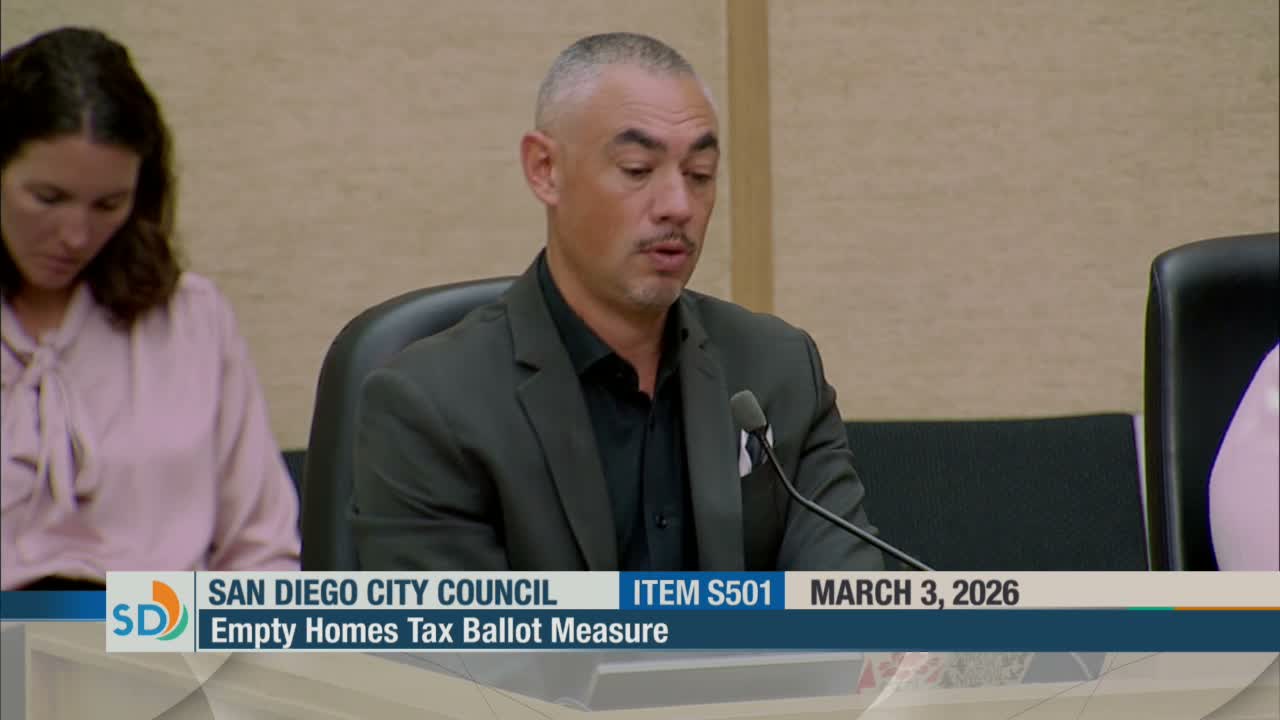
The San Diego City Council voted 8–1 on March 3 to place an "empty homes" tax measure on the June 2, 2026 special election ballot after a full-day presentation and more than an hour of public comment. The proposal, put forward by Councilmember Elo (Ilo) Rivera, would create a progressive excise tax on residential units left vacant for more than 182 days a year, with higher surcharges for corporate owners.
Deputy Chief of Staff Maya Rosas outlined the measure’s mechanics: an $8,000 annual tax per empty home beginning in 2027, rising to $10,000 in 2028, with CPI adjustments from 2029 onward; a corporate surcharge of $4,000 in 2027 ($5,000 in 2028) would be assessed on corporate-owned empty homes. Rosas cited treasurer data identifying roughly 5,140 candidate units, concentrated in Downtown, La Jolla, Pacific Beach and Peninsula.
The Office of the Independent Budget Analyst (IBA) presented conservative revenue projections accounting for exemptions and anticipated owner behavior. Using treasurer data and a modeled exclusion range informed by other cities’ experience, the IBA estimated net general fund revenue of about $9.2 million to $21.4 million in the first full year (FY2028) and $10.4 million to $24.2 million in year two — noting that revenue could decline over time if units convert to rentals or are sold, which is a stated policy goal.
Councilmembers and members of the public debated legal and operational questions throughout the meeting. Opponents, including representatives of local realtor organizations and some homeowners, warned of litigation risk (citing San Francisco’s vacancy tax litigation), privacy and administrative burdens, potential impacts on seniors and family-owned second homes and the possibility of unintended consequences such as conversions to short-term rentals. Supporters — including housing advocacy groups, labor unions, students and renters — argued the measure would discourage speculative holding of homes, create more long-term rental opportunities, and generate funds that support city services used by residents.
Councilmembers asked staff and the treasurer about exemptions and implementation. The measure includes a set of exclusions and exemptions for disaster periods, owner death, probate, military deployment, bona fide leases and situations where family members occupy a property; the treasurer’s office said it would verify claims using documentation similar to existing Rental Unit Business Tax exemptions.
Councilmember Ilo Rivera, who authored the measure, framed it as a targeted tool to change incentives and help San Diegans stay in the city. Councilmember Campillo said he would vote no, citing concerns about receiving a detailed legal memo analyzing litigation risk; other members expressed confidence in the work the city attorney’s office and outside counsel had done to craft the proposal. The council recorded a final vote of 8 to 1 to move the measure to the ballot and to authorize the city attorney, IBA and city auditor to prepare the ballot materials and fiscal analysis.
Because the action places the measure on the ballot, the treasurer’s office will continue preparing administrative systems, and the IBA and city auditor will prepare required fiscal analyses for the voter pamphlet. If approved by voters in June, staff estimated the tax would be effective Jan. 1, 2027, with billing in 2028 and treasurer-reported administrative costs and staffing in the proposal.