Get Full Government Meeting Transcripts, Videos, & Alerts Forever!
Get email alerts on the Energy Infrastructure topic
No spam. Unsubscribe anytime.
Planning commission approves North Johnson battery storage site with updated safety conditions
Summary
The commission approved a conditional use permit for a 2.2‑acre battery energy storage facility near the SDG&E peaker plant, permitting up to 12‑foot screening walls and requiring an evacuation plan, 24/7 monitoring and other fire‑safety measures; the applicant said the project will use Tesla MegaPacks with refrigerated cooling plates and remote monitoring.
The Alcon Planning Commission approved a conditional use permit for a battery energy storage facility on a 2.2‑acre site at the southwest corner of Benedict Avenue and North Johnson Avenue, adjacent to the SDG&E peaker plant. Staff described the project as substantially the same as one the commission approved in 2021 before that approval expired, but noted the resubmission incorporates updated fire‑safety standards and conditions.
Staff said the applicant requested flexibility to use screening walls up to 12 feet tall (the draft resolution originally referenced 10 feet) to accommodate equipment dimensions and foundations; the fencing will be set back and buffered by landscaping. The resolution includes conditions requiring an evacuation plan and additional safety measures that reflect recent changes in battery technology and fire‑safety practice.
Applicant representative Gary Franzen described the planned equipment as Tesla MegaPacks with refrigerated cooling plates and a battery management system that monitors temperature and electrical characteristics; the system includes remote 24/7 monitoring and emergency‑stop controls that can isolate the site. "They actually the batteries actually sit on top of cooling plates ... it circulates very cold water into that cooling plate to keep all the batteries at the cell temperatures that they need to maintain," Franzen said. He added there are sitewide emergency‑stop mechanisms and a remote operations center that monitors the system continuously.
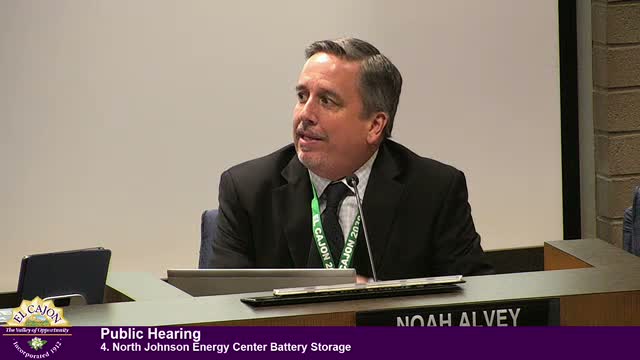
Commissioners asked technical questions about human‑override controls and monitoring; the applicant confirmed e‑stop buttons on the equipment and sitewide breakers and said the facility will be monitored 24/7 by remote operators. Staff and the fire marshal reviewed safety requirements and recommended conditions that aim to increase safety compared with earlier installations.
A motion to adopt the CEQA exemption and the CUP, including updated safety conditions and the 12‑foot screening height flexibility, carried unanimously. The project now moves into the permitting and construction phase subject to conditions of approval and required permits.
Next steps: applicant to finalize equipment specifications, implement the required evacuation and safety plans, and obtain any permits required by state and local agencies; staff will enforce conditions through the standard permit compliance process.