Get Full Government Meeting Transcripts, Videos, & Alerts Forever!
Get email alerts on the Budget And Finance topic
No spam. Unsubscribe anytime.
El Cajon council approves ARPA reallocations and three grant agreements
Summary
The council approved three ARPA-funded grant agreements — up to $609,950 for tenant improvements at 405 E. Lexington Ave., $150,000 for Arabic outreach, and a minimum $300,000 downtown reinvestment program — and accepted staff ARPA reallocations to avoid returning roughly $1.14 million to the federal government.
The El Cajon City Council voted unanimously Oct. 22 to approve three resolutions that reallocate remaining American Rescue Plan Act (ARPA) funds and establish grant agreements with local partners.
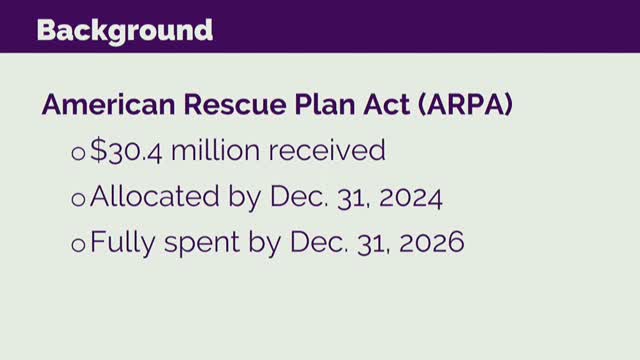
City Manager Graham Mitchell told the council the city received $30 million in ARPA funding, has already spent $13.5 million and either spent or allocated roughly $29.3 million through contracts and RFPs, leaving about $1.14 million unallocated that must be committed before the federal deadline. Staff proposed four uses of the remaining funds, including $68,000 for wellness equipment at four fire stations and three grant agreements.
Council approved: (1) a grant agreement not to exceed $609,950 with the Chaldean Community Council to complete tenant improvements at 405 East Lexington Avenue, structured as a pass-through with a roughly 10% construction-management fee; (2) a $150,000 grant to Newcomer Support and Development to purchase equipment and produce Arabic-language outreach (monthly updates, quarterly videos and emergency communications); and (3) a minimum $300,000 funding agreement with the Downtown El Cajon Business Partners for downtown public improvements. Council then voted to accept the proposed ARPA adjustments as outlined by staff.
Mitchell and staff emphasized federal procurement and reporting rules will apply to each agreement. About the Chaldean Community Council arrangement, Mitchell said the organization would act as the city’s agent to carry out work the city had already committed to; payment would be made after work completion, invoicing and verification. He said standard warranties and federal vendor-registration requirements (SAM registration) would apply.
During council questions, staff clarified that leftover dollars from other projects could legally be redirected into existing programs only if there is a proper procurement and contract in place; routine reallocation still requires a contracting partner and compliance with ARPA rules. Council members pressed staff about risk-mitigation clauses; staff confirmed contracts include termination-for-cause and termination-without-cause provisions.
Mohammed Tuama, representing Newcomer Support and Development, spoke in support of the Arabic-outreach proposal and described the group’s decade-long relationship with the city. He said the requested equipment could also be used by city staff for broader social-media needs.
The council’s approval keeps the recommended ARPA reallocations on track to be spent or committed within the federal timelines and directs staff to implement the grant agreements under the stated procurement and reporting conditions.