Get Full Government Meeting Transcripts, Videos, & Alerts Forever!
Get email alerts on the Surveillance topic
No spam. Unsubscribe anytime.
Council hears ALPR results as closed-session notice flags state inquiry into data-sharing
Summary
Police chief reported the city’s automated license-plate-reader pilot recovered 128 vehicles and supported 151 arrests; council discussed privacy and data-use limits. The city later met in closed session on a potential Attorney General investigation alleging improper sharing of ALPR data; no action was reported.
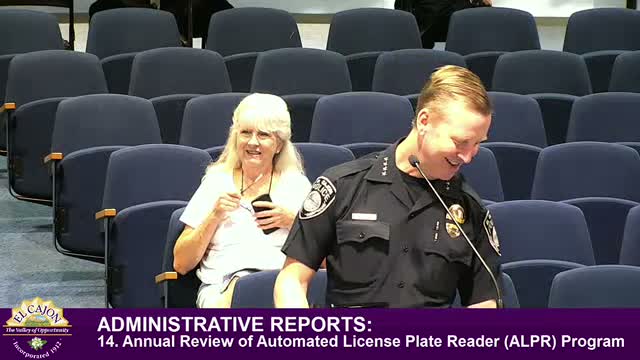
The El Cajon police chief presented the city’s first annual review of its automated license-plate reader (ALPR) system, describing a pilot that began with 40 fixed cameras. Staff reported 151 arrests, 128 recovered vehicles (with a total recovered value above $1.2 million), and several seizures of illegal firearms and controlled substances tied to investigations aided by the system.
The chief described adding a single pan-tilt-zoom camera to address reported problems around the trolley platform at Marshall and now (street name as pronounced in the presentation), and said staff will evaluate expanding coverage if warranted. Council members praised the return on investment: one council member calculated an approximate ROI based on $114,000 in annual service costs and $1.2 million in recovered vehicle value. The chief and council discussed acceptable uses of ALPR data; the chief said the system is currently used for felony vehicles, Amber Alerts, civil alerts and missing-persons work. Council also asked about data security; staff said they were not aware of breaches.
Later in the meeting the city entered closed session on a potential litigation matter after the city attorney read a notice referencing a communication from the California Attorney General’s office alleging the El Cajon Police Department may have shared ALPR data in violation of state law. The city attorney cited California Civil Code section 1798 (as referenced in closed-session notice) and said the notice had been issued by the Attorney General’s office; the council reported after closed session that no action was taken.
Next steps: the city will maintain the pilot, consider targeted expansion, and monitor any inquiry from state authorities; staff signaled they would return with additional detail or recommendations if needed.