Get Full Government Meeting Transcripts, Videos, & Alerts Forever!
Get email alerts on the Qualified Immunity topic
No spam. Unsubscribe anytime.
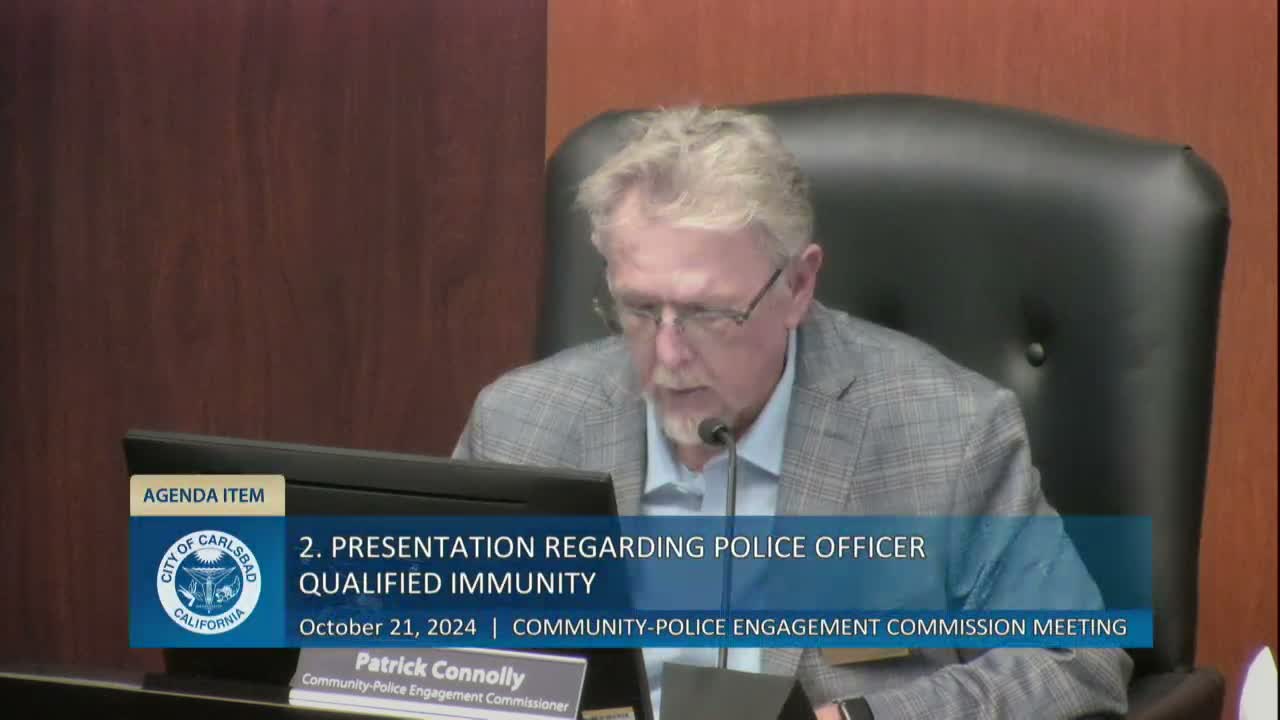
Carlsbad police chief explains qualified immunity, urges continued training
Summary
Police Chief Shipley told the Community Police Engagement Commission that qualified immunity is a judicial doctrine that protects officers from personal liability unless they violate 'clearly established' constitutional rights, reviewed recent case law, and described department training and policy updates.
Chief Shipley told the Community Police Engagement Commission that qualified immunity is a judicial doctrine intended to balance officer accountability with protection from frivolous personal lawsuits. "Qualified immunity at a high level is a judicial doctrine," he said, adding that it protects officers from personal liability when their conduct is "reasonably consistent" with legal and policy standards but is "not absolute."
In a roughly 90-minute presentation and follow-up exchange, Shipley reviewed landmark precedents such as Graham v. Connor and Tennessee v. Garner and described a recent Ninth Circuit vehicle-stop panel decision that scrutinized high-risk stop tactics. "Just because the officers are following policy doesn't mean that they were acting appropriately," he said of the Ninth Circuit panel review, noting that courts may find officers lose qualified immunity if they violate a "clearly established right."
Commissioners pressed for local context. When asked whether the Carlsbad Police Department has been party to qualified-immunity rulings, Shipley said the department has faced civil litigation but he was not aware of a local qualified-immunity decision. "We have had cases that have gone before federal civil rights courts," he said, adding that many such matters settle and that active civil cases are not typically publicized.
Shipley described the department's approach to reducing liability and improving decision-making: ongoing case-law updates, mandatory training bulletins and videos, and quarterly or scenario-based training for all sworn personnel and rangers. He said the department issued a training bulletin and mandatory video on a recent high-risk vehicle-stop decision and that officers must acknowledge and document completion in training records. "We do receive ongoing case law updates," he said.
On the question of whether nearby officers can face exposure for failing to intervene, Shipley said that in some cases officers in the vicinity have been criminally charged and that civil exposure may follow. He noted that California law imposes an expectation that officers will intervene if they observe excessive force.
The presentation closed with Shipley emphasizing recruiting, retention and scenario-based training — including video vignettes and VR-like exercises — as primary measures to help officers make reasoned decisions under stress.