Get Full Government Meeting Transcripts, Videos, & Alerts Forever!
Get email alerts on the Energy topic
No spam. Unsubscribe anytime.
Clean Energy Alliance tells Carlsbad council it has high local participation and will implement a 5.2% average rate change Nov. 1
Summary
CEA CEO Greg Wade told the Carlsbad City Council the community-choice aggregator serves Carlsbad with a reported 91% account participation, is targeting 100% renewable energy by 2035, and will implement a board-approved rate change set to take effect Nov. 1 that averages a 5.2% increase (about $10 per month).
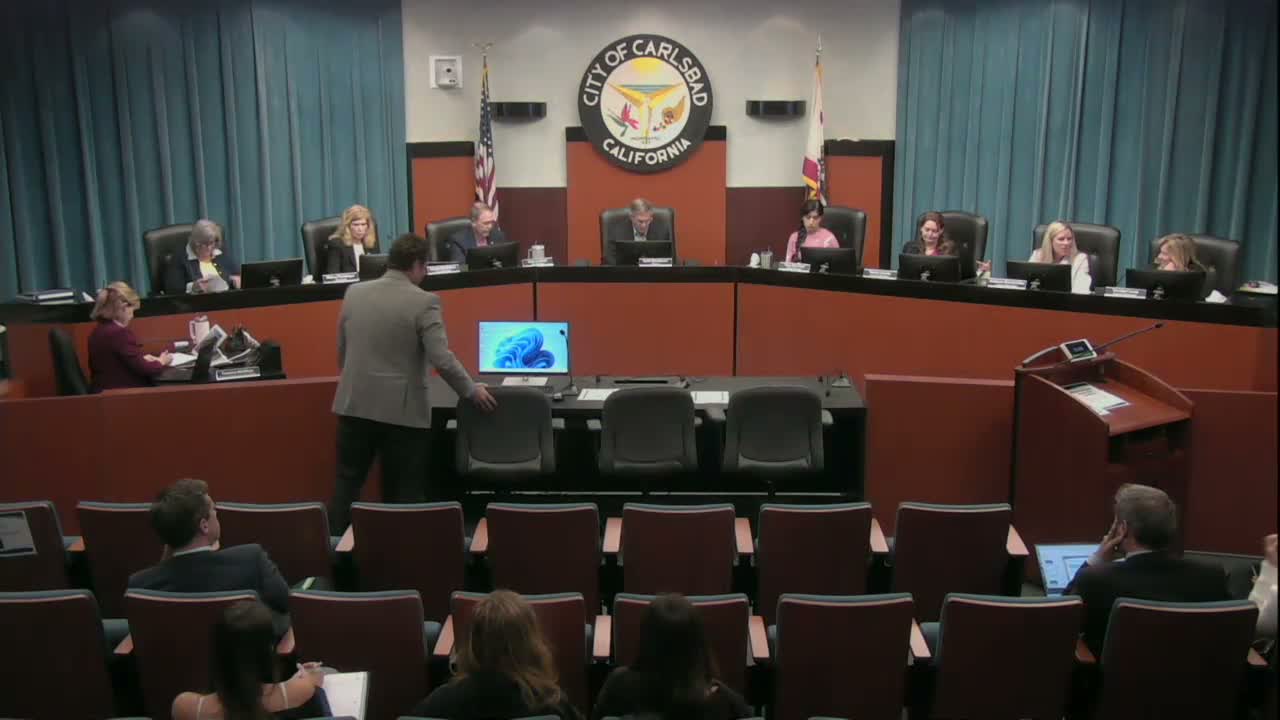
Greg Wade, chief executive officer of the Clean Energy Alliance, told the Carlsbad City Council on Oct. 14 that the Community Choice Aggregation (CCA) serving Carlsbad now covers a large majority of utility accounts in the city and is expanding programs intended to cut greenhouse-gas emissions.
"Carlsbad has a participation rate in CEA of 91%," Wade said, adding that the CEA territory as a whole has a 94% participation rate and that the CEA default product is a roughly 75% carbon‑free product. He said 213 municipal accounts have opted up to a 100% renewable product and 161 have chosen a 50% renewable product.
The chief executive outlined a suite of local programs, including a "solar-plus" battery program for single-family homes that requires no upfront cost, a proposed local feed-in tariff for larger commercial projects, and an equitable building-decarbonization pilot tied to a sizable regional grant. He said the JPA's procurement policy targets 100% renewable service to member agencies by 2035 and that the organization's minimum renewable mix is 50% under the joint‑powers agreement.
Wade also reviewed CEA's budget and recent board action on rates. "The increase that we have… will go into effect on November 1, and it's set to sufficiently cover our costs," he said, adding that the change will "result in an average overall bill increase to customers of 5.2%, which is approximately $10 per month." He said the organization has built reserves and a line of credit to manage procurement costs and market volatility.
Council members asked for clarifications about the participation figures and rate-setting process. Council member Melanie Burkholder asked whether the 91% figure referred to accounts or to population; Wade replied the number referred to accounts. Council member (and CEA board member) Mayor Pro Tem Battelle was identified as the city's board representative and Wade described the CEA board and local rate‑setting process, noting the California Public Utilities Commission retains regulatory authority over investor‑owned utilities while the CEA board sets rates for the JPA's product.
Wade said CEA allocated $600,000 for programs in the current fiscal year with plans to scale to $2 million next year and to increase program funding gradually in subsequent years. He said program allocation would reflect each member city's share of load and revenues.
The council did not take immediate legislative action but aired questions and thanked CEA staff for the report. Wade said staff would continue to monitor SDG&E's rates and market conditions and return with more information as needed.