Get Full Government Meeting Transcripts, Videos, & Alerts Forever!
Get email alerts on the Housing Element topic
No spam. Unsubscribe anytime.
Upland council readopts 2021–2029 housing element to preserve state compliance and zoning capacity
Summary
The Upland City Council unanimously adopted a resolution readopting the 2021–2029 housing element after staff and consultants described analyses showing the city can demonstrate capacity for the 5,686‑unit RHNA allocation; councilors pressed for clarification on senior housing, ADU parking and fire‑flow constraints.
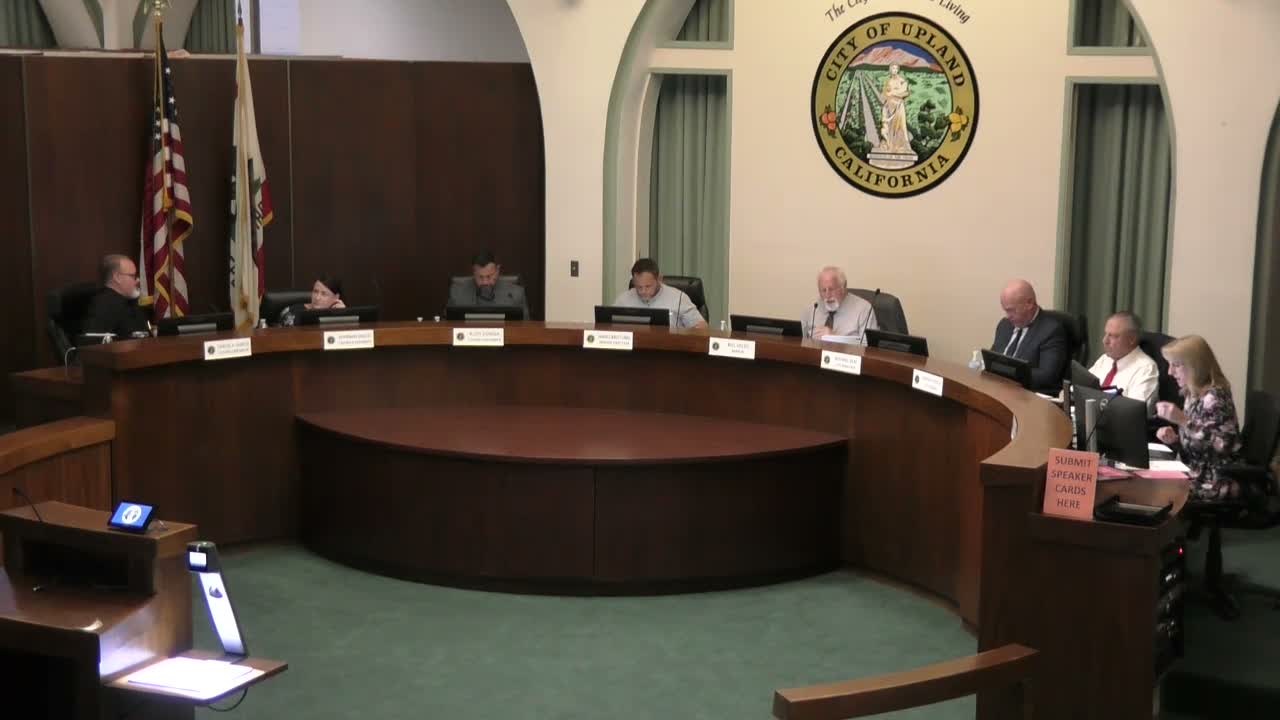
The Upland City Council on Monday readopted the city’s 2021–2029 housing element to maintain compliance with state requirements and preserve the zoning capacity tied to a regional housing needs assessment (RHNA) allocation of 5,686 units.
City planning staff and consultants from Michael Baker International delivered a detailed presentation summarizing changes since the element’s prior adoption, including a larger Affirmatively Furthering Fair Housing (AFFH) chapter, additional substantiation of sites and five new or revised programs with geographic targets and quantifiable metrics. Robert Dalquist, the city’s development services director, introduced the project and consultants before planning staff walked the council through the background and next steps.
"Our responsibility is to make sure we have the land and the zoning that can achieve those numbers," said Dan Wherry of Michael Baker International, describing the sites inventory and how the city demonstrates capacity. Consultant Shannon Liska outlined revisions made at the state’s request, including an expanded AFFH analysis, evaluation criteria for nonvacant sites and added program metrics to target South Upland and other areas of need.
The presentation noted the practical effects of noncompliance: loss of eligibility for some state funds, exposure to fines or litigation, and the potential for the state’s "builder’s remedy" to allow projects inconsistent with local zoning if the city lacks an HCD‑certified housing element. Staff emphasized that readoption tonight does not itself rezone property; rezonings required by the element will come back to the planning commission and city council in subsequent hearings.
Council members asked detailed questions about senior and workforce housing definitions, ADU parking requirements and enforcement, and how the city will address buildability constraints such as fire‑flow. A councilor pressed whether a 'senior' category in some programs applies at age 55 or 65; staff said 55 is the common qualifying age for some program definitions but noted that program eligibility and special‑needs approaches vary by policy.
On ADUs, staff said state law limits parking requirements for ADUs within a quarter‑mile of transit and that local rules require one on‑site parking space elsewhere unless the garage is converted. Consultants noted the housing element commits to annual reporting (the city's Annual Progress Report) and to monitoring program outcomes so HCD can verify progress.
Two members of the public urged the council to protect downtown parkland while acknowledging the need for housing. Natasha Walton of People for Upland Parks asked the council to designate at least one acre of public parkland within an 18‑acre downtown city‑owned parcel rather than allow wholesale conversion to high‑density housing. Mark Gutlik warned that some site decisions could constrain future transportation options.
After discussion, the council first found the general plan amendment exempt from the California Environmental Quality Act and then adopted the resolution approving the housing element update. Both motions were moved, seconded and passed; the transcript records the votes as passing unanimously.
Next steps staff outlined include notifying the California Department of Housing and Community Development (HCD) of the readoption, completing the zoning changes listed in the housing element to achieve full compliance, and returning to the planning commission and council for those rezoning hearings. The city will also incorporate the new programs and the AFFH analysis into annual progress reporting to HCD.
The council meeting packet and the housing element draft include the sites inventory, program descriptions (including an ADU bonus program for large lots with deed‑restricted affordable units), and details on required rezonings; staff said the rezonings will undergo separate public hearings in the coming months.