Get Full Government Meeting Transcripts, Videos, & Alerts Forever!
Get email alerts on the Land Use Leases topic
No spam. Unsubscribe anytime.
Council approves Surf Sports lease amendment, terminates parts of 1983 deed restrictions with conditions including trail deadline and $100,000 annual fund
Summary
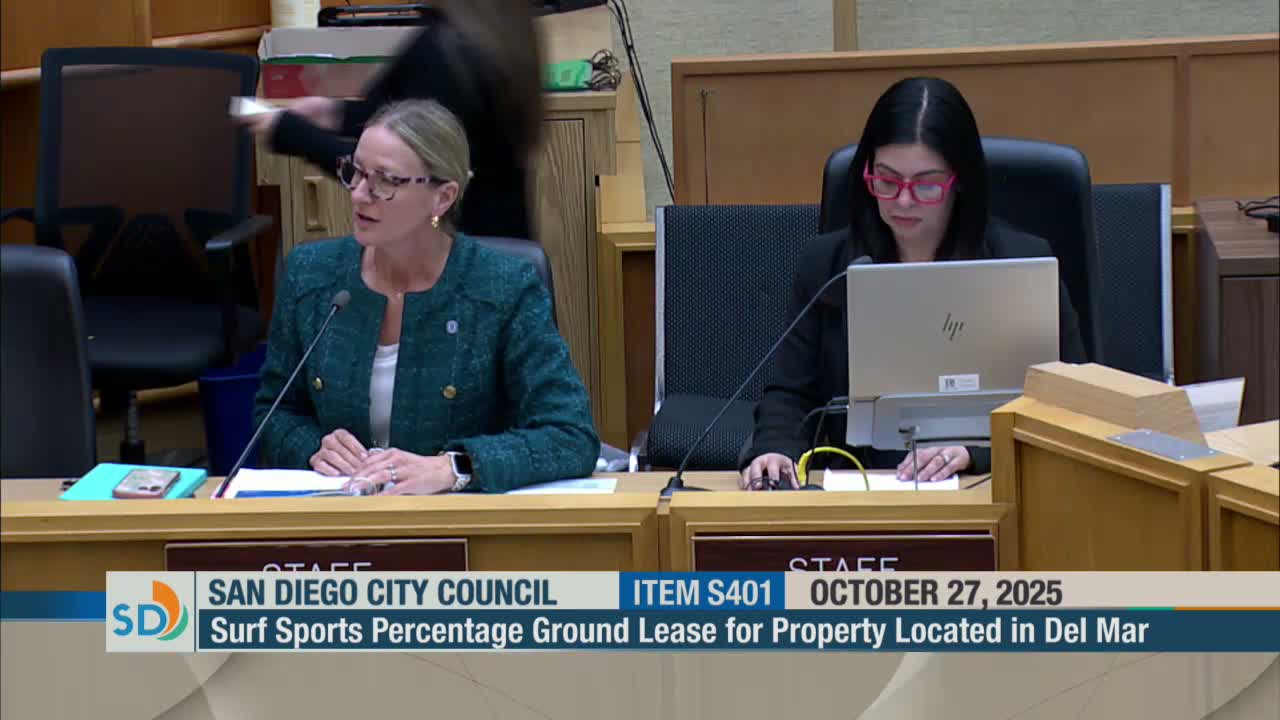
After hours of public testimony for and against, the council approved a first amendment to the Surf Sports ground lease and a termination agreement for portions of the 1983 grant deed. The council added conditions: completion of the Coast to Crest Trail by 06/30/2027, stronger enforceability language in the lease, and a minimum $100,000 annual payment to the Park & Recreation Opportunity Fund; the final vote was 6–2.
The City Council voted Oct. 27 to authorize a first amendment to the long-term ground lease with Surf Sports LLC and to approve a termination agreement that removes certain use restrictions from Exhibit B of a 1983 grant deed — subject to added conditions the council negotiated during the hearing.
Economic Development Director Christina Biblar and deputy real estate director Lucy Contreras told the council the deed’s Exhibit B restricted large assemblages and required the city to preserve affected lots as natural open space. Staff said recent litigation, ambiguities in the deed and decades of inconsistent enforcement created repeated disputes. They argued the restrictions could be terminated because the grantor (Ocean Industries) still owned parcels in the benefited land and therefore the legal mechanism exists to conclude the restriction.
Surf Sports (SURF) representatives described investments in fields and irrigation and said their tournaments generate regional economic activity and scholarship opportunities for local athletes. “Serve Sports Park is where young kids identify their strengths…Every year, local kids earn millions of dollars in scholarship money on these fields alone,” said Brian Engie, chief operating officer for Surf Sports, in an emotional presentation accompanied by community letters and a video.
Opponents — including homeowners, environmental groups, the San Dieguito River Valley Joint Powers Authority, the cities of Del Mar and Solana Beach, and multiple planning groups — said the site has been operated far more intensively than allowed by the deed and existing lease, citing traffic congestion on two-lane roads, public-safety concerns, environmental impacts to the river valley and failure to complete required trail and mitigation items under earlier agreements.
Council members pressed staff and Surf counsel on enforcement: how a revised lease would be monitored, what would happen if traffic mitigation commitments were not carried out, and whether the amendment added meaningful remedies beyond default notices. City staff said the first amendment clarified the definition of a “large event” (counting sporting events by field usage), required traffic management updates, added calendar and trash-abatement obligations, and provided clearer metrics to enforce the 40-day limit staff counts as consistent with historical use. Staff said the amendment gives the city more enforcement tools than the prior lease, up to and including lease default and termination if persistent violations occur.
During the hearing the council negotiated two additional conditions and directed staff to incorporate them into the first amendment before execution: completion of the Coast to Crest Trail improvements required by the site development permit no later than June 30, 2027; and an annual minimum contribution of $100,000 to the Park & Recreation Opportunity Fund to support city recreation programs. Council also directed the Department of Economic Development to ensure rent and percentage-rent adjustments occur by Sept. 1, 2026 and to provide evidence that lessee payments are current.
The motion to approve the first amendment as modified passed 6–2, with Councilmembers Campillo and Von Wilpert voting no and Councilmember Campbell absent. Council President framed the result as a step toward stronger city oversight, while opponents said the action risked weakening the original public bargain that secured open space decades ago.