Get Full Government Meeting Transcripts, Videos, & Alerts Forever!
Get email alerts on the Council Meeting topic
No spam. Unsubscribe anytime.
San Diego City Council reads closed-session items; public commenters press for transparency on Midway appeal, surveillance procurement and other issues
Summary
At a Nov. 17 special meeting the San Diego City Council read several closed-session items covering litigation, an executive-director appointment and labor negotiations; public commenters urged disclosure of closed-session outcomes and raised concerns about a Midway appeal, CEQA, ALPR surveillance vendors, tobacco policy and marijuana-department transparency.
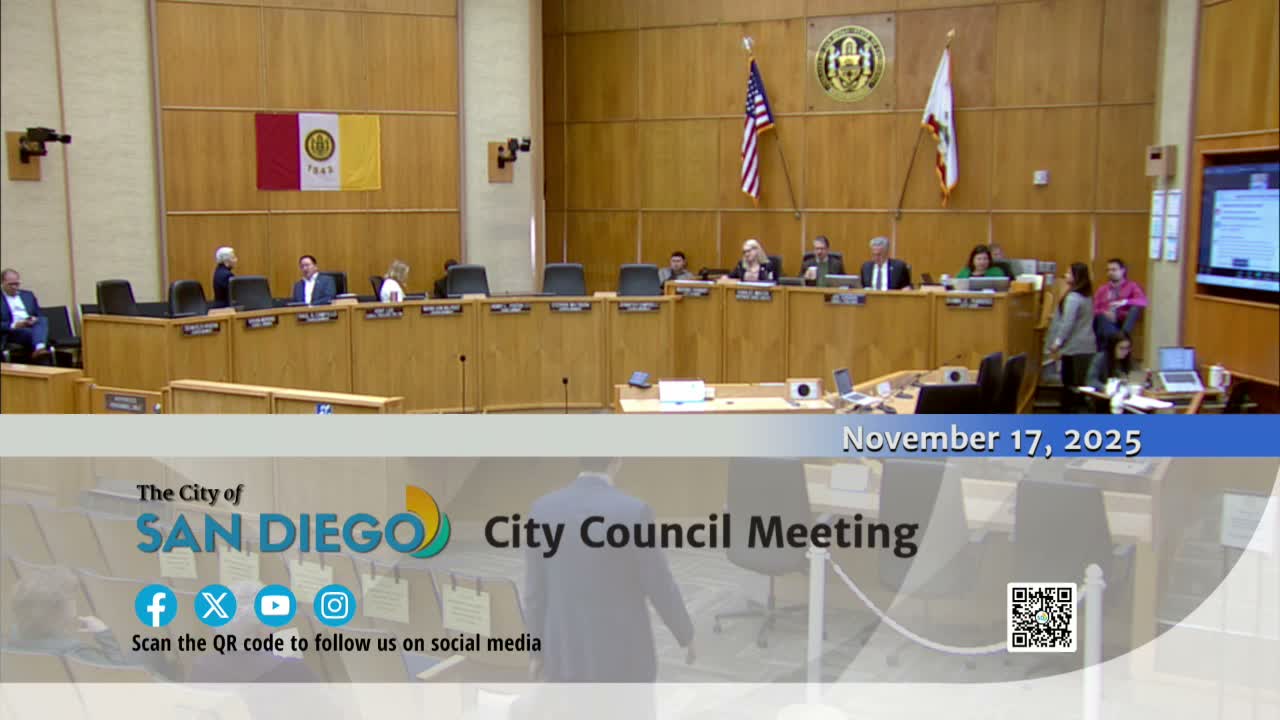
Council President Lacava called a special City Council meeting to order on Nov. 17, 2025 and the clerk, Diana Fuentes, read a slate of closed-session items that included existing litigation matters, a public-employment appointment for the executive director of the Commission on Police Practices, and labor-negotiation items under California Government Code provisions.
The clerk read specific closed-session references, including litigation listings the transcript labeled "SCS-1 Save Our Access versus City of San Diego," "SCS-2 Juan Moreno versus City of San Diego," and a flood-related matter labeled SCS-3. The clerk also noted the council would appoint the executive director of the Commission on Police Practices and later determine compensation in an open meeting if reportable outcomes result from closed session.
Public commenters used both the closed-session public-comment period and a later non-agenda period to press the council on transparency and policy.
Paul Krueger urged the council to set a public time to reconvene after closed session and to disclose how each member voted, saying failing to do so would "disenfranchise" those who want to hear the outcome. Kate Callan urged the council not to pursue a closed-door appeal in the Midway Rising litigation and argued that an incomplete environmental impact report (EIR) should be fixed in public rather than appealed. In related comments, Mandy said appealing the Midway matter instead of correcting the EIR "sends a message that the city is prioritizing a predetermined development outcome over public trust and legal compliance."
Other speakers raised procurement, public-health and administrative concerns. Blair Beekman urged the city to consider alternatives to the current automatic license-plate-reader (ALPR) vendor and recommended a multi-stakeholder vetting process; Barbara Gordon and Madison urged stronger tobacco and vaping restrictions to protect young people; and Becky Rapp requested a future agenda item directing staff to produce a transparency report and audit of the city's marijuana department (tax revenue, outstanding penalties and enforcement actions) before expanding delivery permits.
Al Del Mastro, identifying himself as a small housing provider, criticized proposed policies affecting landlords and questioned city billing and water-charge practices. A remote speaker (John Stumpf) questioned a local press account of a homicide press release and disputed the reported location, saying the motel named in police materials was not in City Heights.
Why it matters: The closed-session items concern litigation exposure and high-profile administrative appointments and were the subject of sustained public attention; multiple speakers framed the issues as matters that should be handled in public. City officials said the council expected to be in closed session most of the day and would report any appropriate reportable actions when it reconvened.
What was not decided: The meeting recessed into closed session; the transcript does not include the council's report-out or any open-session votes on the items read into the record.