Get Full Government Meeting Transcripts, Videos, & Alerts Forever!
Get email alerts on the Utilities topic
No spam. Unsubscribe anytime.
SDG&E forecasts small delivery increase; public and council press utility on high rates and CPUC intervention
Summary
SDG&E presented a preliminary estimate of about $4/month added to the combined natural gas and electric delivery portion of customers' bills and described potential wildfire‑mitigation charges; many San Diegans urged the council to press the utility and intervene at the CPUC to address high rates and company profits.
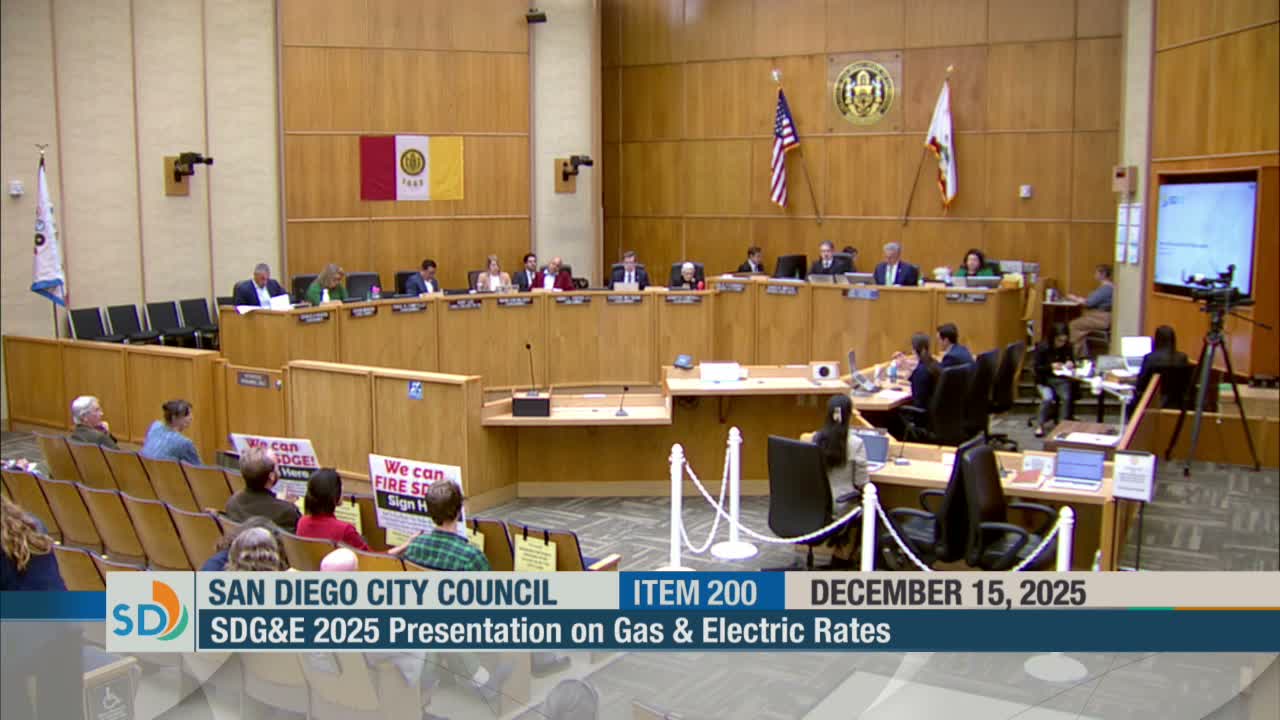
San Diego Gas & Electric representatives briefed the City Council on Monday about elements driving local utility bills and said they currently estimate about a $4‑per‑month increase to the delivery portion of combined gas and electric bills in January. The presentation prompted an extended public comment period in which dozens of speakers told the council bills are unaffordable and asked the city to take a more active role at the California Public Utilities Commission.
At the start of the presentation, company representatives described the three principal components of customer bills: infrastructure costs, state‑mandated programs collected through rates, and commodity (the physical electricity or gas). Adam Pierce, SDG&E’s vice president of energy procurement and electric rates, said staff’s preliminary estimate pointed to about $3 on the electric side and $1 on the gas side for the delivery portion of the bill.
Pierce also cautioned that several pending regulatory decisions could affect January bills further, including a potential CPUC decision on wildfire mitigation costs that could raise bills by roughly $5 if adopted as proposed. He said the company and regulators are monitoring multiple proceedings and that some items could roll off customer bills later in 2026.
Public comment was dominated by residents and advocacy groups demanding swifter action on affordability and criticizing SDG&E’s profits. "SDG&E is a for‑profit monopoly," said a string of speakers from neighborhood and climate organizations. Gail Viamante, a senior on a fixed income, told council: "You could save billions for the city and its residents if SDG&E just reduced its profit." Several commenters urged the city to pursue public power or to become an active party in upcoming CPUC proceedings.
Council members across the dais pressed SDG&E on whether it would accept a lower authorized return in the CPUC cost‑of‑capital proceeding and whether it uses shareholder funds for direct customer relief. SDG&E representatives said some shareholder‑funded programs (including a “Neighbor to Neighbor” arrearage relief fund) and potential removal of inefficient state‑mandated programs could help reduce customer bills in 2026 and 2027. The company also said it plans to present a legislative slate seeking to remove certain state‑mandated costs from rates.
City staff said the city already files for party status at the CPUC in certain proceedings and that the city can continue to intervene in rate cases; Heather Warner, a deputy director in the city energy division, confirmed the city has filed motions for party status in prior general rate cases and could do so going forward.
What comes next: SDG&E said it will pursue a mix of administrative and legislative steps to try to limit near‑term pressure on bills and will meet with councilmembers to build support for proposals to remove inefficient, state‑mandated programs from rate recovery. Councilmembers asked the mayor’s office to consider active engagement at the CPUC and additional hearings or staff actions to represent ratepayer concerns.